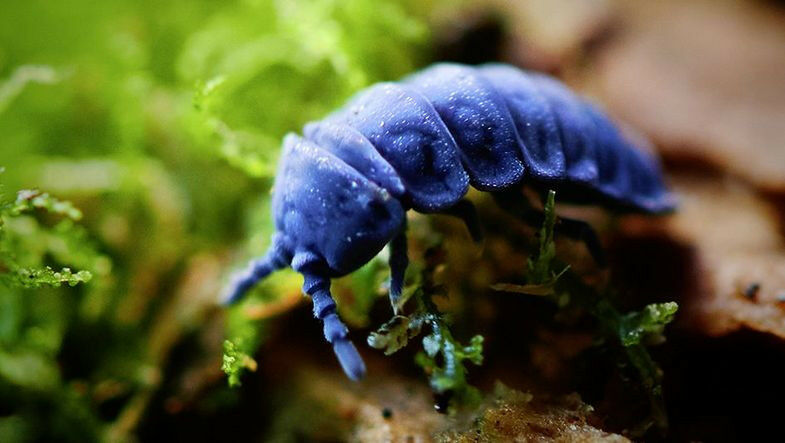
Die Collembole Tetrodontophora bielanensis in ihrem natürlichen Lebensraum. Foto: Stephan Floss/Leibniz Institut für Polymerforschung Dresden
Die Collembole Tetrodontophora bielanensis in ihrem natürlichen Lebensraum. Foto: Stephan Floss/Leibniz Institut für Polymerforschung Dresden News from Living organisms use powerful physical principles to control interactions at their surfaces. Researchers at the Leibniz Institute of Polymer Research Dresden, Leipzig University and TU Dresden have now discovered why cholesterol-containing surfaces can exhibit greatly reduced attachment of proteins and bacteria. The interdisciplinary team led by Carsten Werner had previously identified cholesterol as a component of the skin of widespread invertebrates ( collembolae ), which breathe through their skin and therefore need to protect it from contamination. In their paper published in Nature on 22 June 2023, the scientists have now elucidated a repulsive mechanism of cholesterol-containing surfaces. Using experiments, simulations and thermodynamic analyses, they were able to show how the spontaneous change in the orientation of interfacial cholesterol molecules creates an -entropic barrier- that makes cholesterol-containing surfaces repellent. The development of synthetic materials using the discovered principle is promising, as it is important for many products and technologies to effectively minimize the attachment of biomolecules and bacteria.
TO READ THIS ARTICLE, CREATE YOUR ACCOUNT
And extend your reading, free of charge and with no commitment.