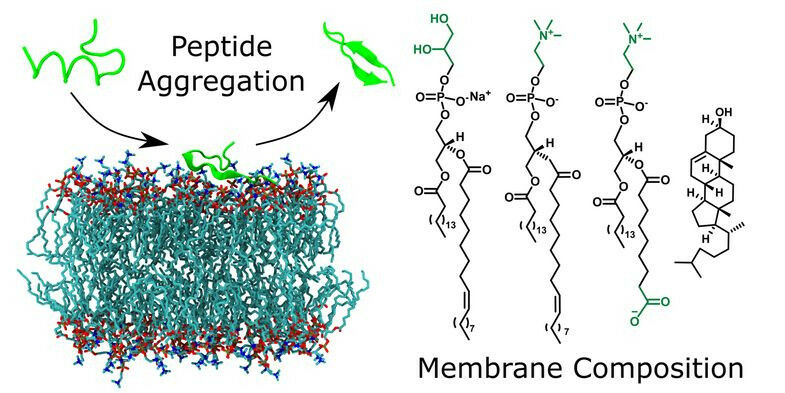
Oxidised model membranes have different effects on peptide fibril formation, driven by membrane surface attraction, peptide charge and peptide structural properties.Image: Leipzig University
Oxidised model membranes have different effects on peptide fibril formation, driven by membrane surface attraction, peptide charge and peptide structural properties. Image: Leipzig University Despite considerable advances in research, there is still no cure for many age-related diseases, such as Alzheimer-s. One hypothesis for the development of Alzheimer's is the aggregation of peptides, i.e. their -clumping-, in the brains of people with the disease. But stress has also been suspected as a possible trigger. Scientists from Leipzig University, Monash University in Australia, the Leibniz Institute of Surface Engineering (IOM) and the University of Göttingen have investigated the links between oxidised cell membranes and peptide aggregation and have now published their findings in the journal Chemical Science. The researchers wanted to better understand how cell membranes in the body influence the structure of peptides - these are molecules made up of amino acids - and their aggregation. To do this, they used model systems that are easy to control experimentally.
TO READ THIS ARTICLE, CREATE YOUR ACCOUNT
And extend your reading, free of charge and with no commitment.