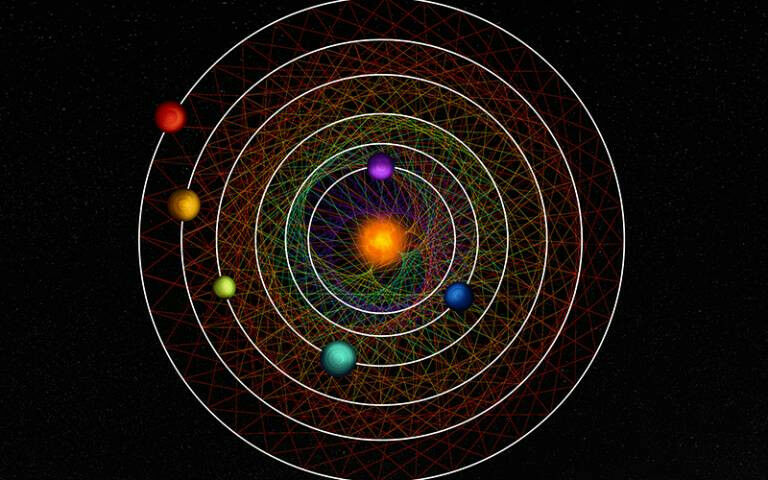
STILL IMAGE IN SPIROGRAPHIC STYLE
STILL IMAGE IN SPIROGRAPHIC STYLE An international collaboration involving UCL researchers has discovered six planets orbiting their central star in a rhythmic beat, a rare case of an "in sync" gravitational lockstep that could offer deep insight into planet formation and evolution. The findings, published in Nature , are particularly valuable as the planets are likely to have been performing this same rhythmic dance ever since the system formed more than a billion years ago. This means the system has not suffered the smash-ups, collisions and mergers that astronomers typically expect in the early days of planet formation, as planets jockey for position. While multi-planet systems are common in our galaxy, those in a tight gravitational formation known as "resonance" are observed by astronomers far less often. In this case, the planet closest to the star makes three orbits for every two of the next planet out - called a 3/2 resonance - a pattern that is repeated among the four closest planets. Among the outermost planets, a pattern of four orbits for every three of the next planet out (a 4/3 resonance) is repeated twice. The study, led by Dr Rafael Luque of the University of Chicago, used data from two satellites, NASA's TESS (the Transiting Exoplanet Survey Satellite) and the European Space Agency's CHaracterising ExOPlanets Satellite (Cheops), which track tiny eclipses that planets make as they cross the faces of their stars.
TO READ THIS ARTICLE, CREATE YOUR ACCOUNT
And extend your reading, free of charge and with no commitment.