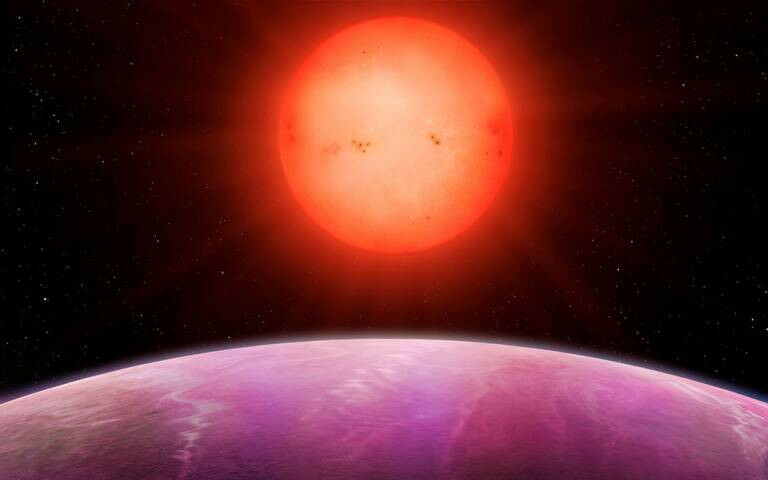
Artist’s impression of sunrise on planet NGTS-1b, a gas giant previously discovered orbiting a low-mass star. Credit: University of Warwick/Mark Garlick
Artist's impression of sunrise on planet NGTS-1b, a gas giant previously discovered orbiting a low-mass star. Credit: University of Warwick/Mark Garlick - Stars with less than half the mass of our Sun are able to host giant Jupiter-style planets, in conflict with the most widely accepted theory of how such planets form, according to a new study led by UCL and University of Warwick researchers. Gas giants, like other planets, form from disks of material surrounding young stars. According to core accretion theory, they first form a core of rock, ice and other heavy solids, attracting an outer layer of gas once this core is sufficiently massive (about 15 to 20 times that of Earth). However, low-mass stars have low-mass disks that, models predict, would not provide enough material to form a gas giant in this way, or at least not quickly enough before the disk breaks up. In the study, accepted for publication in the Monthly Notices of the Royal Astronomical Society (MNRAS) and funded by the UK Science and Technology Facilities Council (STFC), researchers looked at 91,306 low-mass stars, using observations from NASA's Transiting Exoplanet Survey Satellite (TESS), and in 15 cases found dips in the brightness of the light corresponding to a gas giant passing in front of the star. Five out of the 15 potential giant planets have since been confirmed as planets using independent methods.
TO READ THIS ARTICLE, CREATE YOUR ACCOUNT
And extend your reading, free of charge and with no commitment.