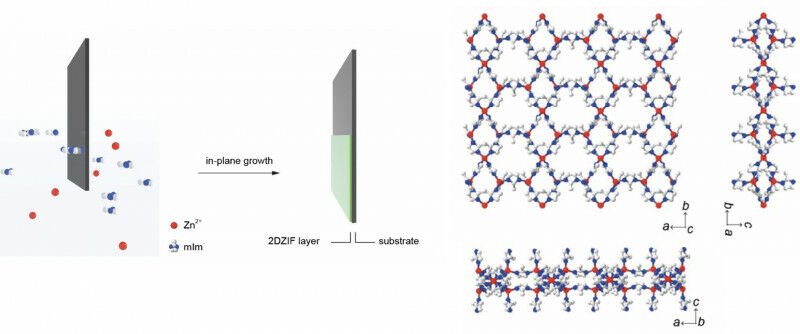
Schematic showing straightforward crystallization of 2d ZIF film by dipping a substrate in ultradilute precursor solution at room temperature (left). Right: Crystal structure of 2d ZIF where white, blue, and red atoms represent carbon, nitrogen, and zinc atoms. Credit: Qi Liu, EPFL.
Schematic showing straightforward crystallization of 2d ZIF film by dipping a substrate in ultradilute precursor solution at room temperature ( left ). Right: Crystal structure of 2d ZIF where white, blue, and red atoms represent carbon, nitrogen, and zinc atoms. Credit: Qi Liu, EPFL. Scientists at EPFL have synthesized the first ever metal-organic frameworks membrane with thickness of just one unit cell. The ultrathin film yields record-high separation performance of hydrogen. Metal-organic frameworks (MOFs) are a class of materials that contain nano-sized pores. These pores give MOFs record-breaking internal surface areas, which make them extremely versatile for a number of applications: separating petrochemicals and gases , mimicking DNA , producing hydrogen , and removing heavy metals , fluoride anions , and even gold from water are just a few examples.
TO READ THIS ARTICLE, CREATE YOUR ACCOUNT
And extend your reading, free of charge and with no commitment.