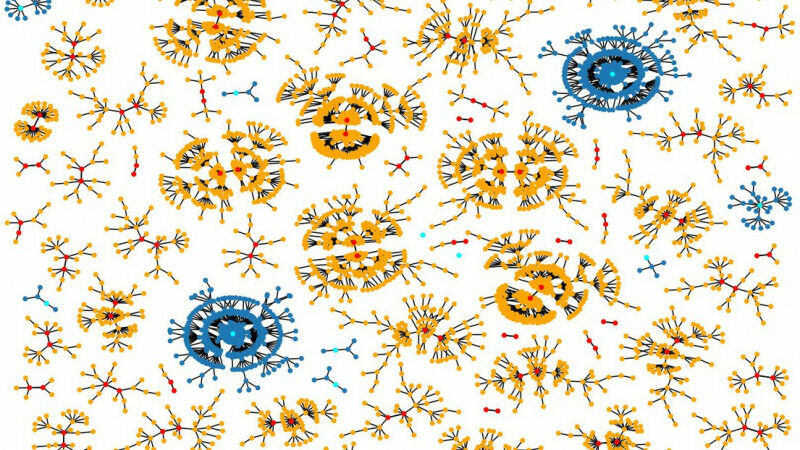
The configuration space of a 3-regular graph with 12 nodes. The attractors in the red/cyan colours, and their basin of attraction is in blue and yellow. Credit: Freya Behrens, EPFL.
The configuration space of a 3-regular graph with 12 nodes. The attractors in the red/cyan colours, and their basin of attraction is in blue and yellow. Credit: Freya Behrens, EPFL. Scientists at EPFL and Charles University have developed a new method to analyze the dynamical, out-of-equilibrium properties of complex disordered systems, such as gold with magnetic impurities or opinions spreading on social media. In physics, a "disordered system" refers to a physical system whose components - e.g. its atoms - are not organized in any discernible way. Like a drawer full of random socks, a disordered system lacks a well-defined, ordered pattern due to various factors like impurities, defects, or interactions between components. This randomness makes it difficult to predict the system's behavior accurately.
TO READ THIS ARTICLE, CREATE YOUR ACCOUNT
And extend your reading, free of charge and with no commitment.