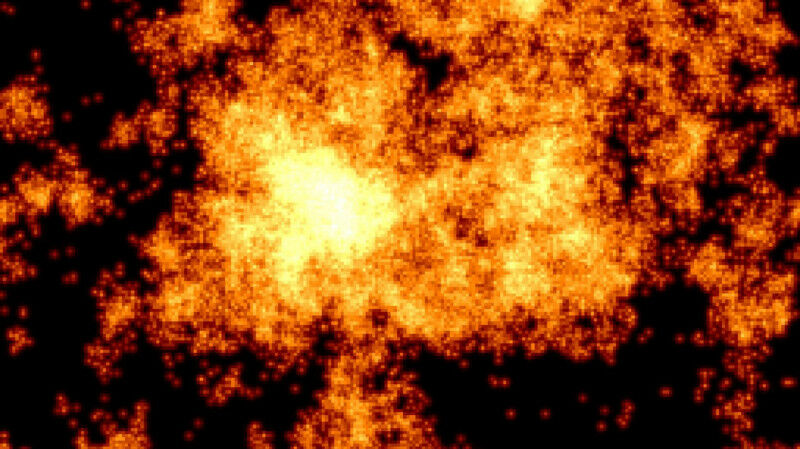
Map of the spatial relaxation in a two-dimensional liquid model. Credit: Tahaei et al 2023.
Map of the spatial relaxation in a two-dimensional liquid model. Credit: Tahaei et al 2023. A collaborative study with EPFL builds a novel theory to explain the puzzling collective behavior of glass-forming liquids at low temperatures, a phenomenon with widespread implications in fields like material science and biology. Glass, despite its apparent transparency and rigidity, is a complex and intriguing material. When a liquid is cooled to form a glass, its dynamics slows down significantly, resulting in its unique properties. This process, known as "glass transition", has puzzled scientists for decades. But one of its intriguing aspects is the emergence of "dynamical heterogeneities," where the dynamics become increasingly correlated and intermittent as the liquid cools down and approaches the glass transition temperature.
TO READ THIS ARTICLE, CREATE YOUR ACCOUNT
And extend your reading, free of charge and with no commitment.