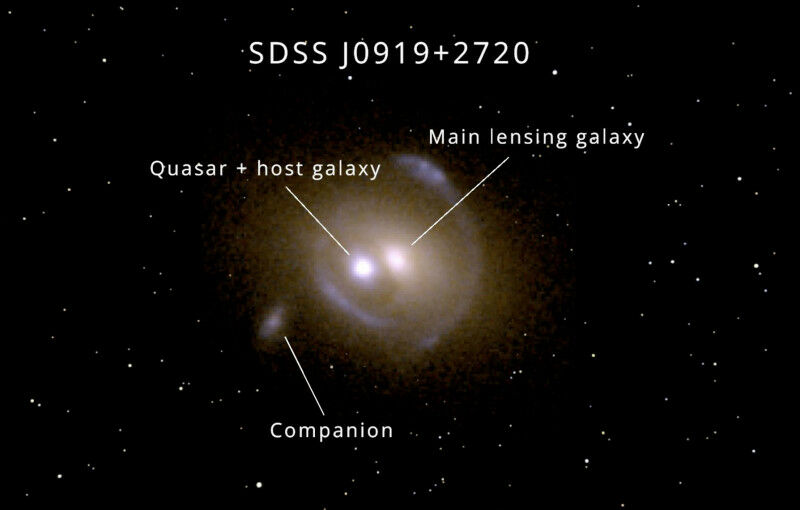
EPFL / Austin Peel, CC-BY-SA.
EPFL / Austin Peel, CC-BY-SA. Scientists have managed to weigh - more precisely than any other technique - a galaxy hosting a quasar, thanks to the fact that it acts as a gravitational lens. Detection of strong gravitational lensing quasars is expected to multiply with the launch of Euclid this summer. A team of researchers from EPFL have found a way to use the phenomenon of strong gravitational lensing to determine with precision - about 3 times more precise than any other technique - the mass of a galaxy containing a quasar, as well as their evolution in cosmic time. Knowing the mass of quasar host galaxies provides insight into the evolution of galaxies in the early universe, for building scenarios of galaxy formation and black hole development. The results are published in Nature Astronomy . "The unprecedented precision and accuracy achieved with gravitational lensing provide a new avenue for obtaining robust mass estimates in the distant Universe, where conventional techniques lack precision and are susceptible to biases," says EPFL astrophysicist Frédéric Courbin, senior author of the study.
TO READ THIS ARTICLE, CREATE YOUR ACCOUNT
And extend your reading, free of charge and with no commitment.