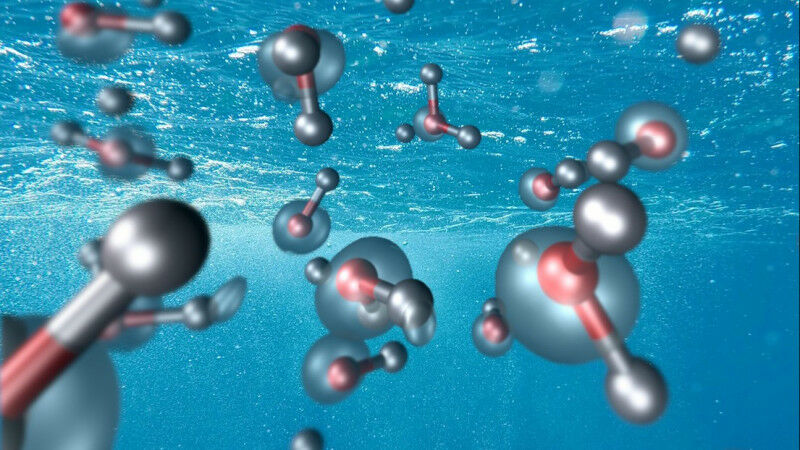
Water molecules and electron density corresponding to the exciton state resulting from photon absorption. Credit: Krystian Tambur (background)/Alexey Tal (water molecules)
Water molecules and electron density corresponding to the exciton state resulting from photon absorption. Credit: Krystian Tambur (background)/Alexey Tal (water molecules) Scientists at EPFL have decoded the electronic structure of water, opening up new perspectives for technological and environmental applications. There is no doubt that water is significant. Without it, life would never have begun, let alone continue today - not to mention its role in the environment itself, with oceans covering over 70% of Earth. But despite its ubiquity, liquid water features some electronic intricacies that have long puzzled scientists in chemistry, physics, and technology. For example, the electron affinity, i.e. the energy stabilization undergone by a free electron when captured by water, has remained poorly characterized from an experimental point of view. Even today's most accurate electronic structure theory has been unable to clarify the picture, which means that important physical quantities like the energy at which electrons from external sources can be injected in liquid water remain elusive.
TO READ THIS ARTICLE, CREATE YOUR ACCOUNT
And extend your reading, free of charge and with no commitment.