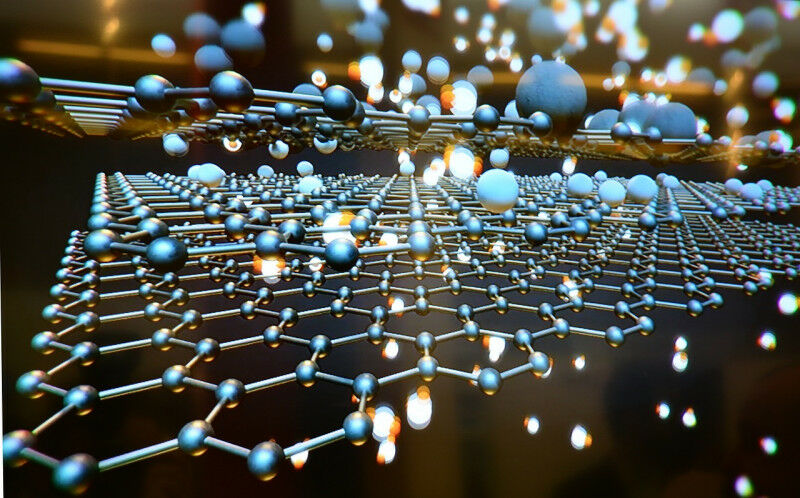
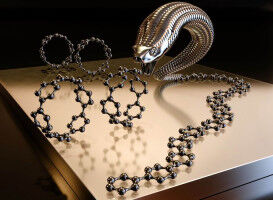
(Image: Pixabay CC0)
(Image: Pixabay CC0) - "This is one of the most important works that this research group has done in its history, and that is saying a lot", especially in a team that is able to characterize and synthesize its own carbon nanostructure materials, which has made it one of the most important groups "not only in Europe, but also internationally". This is what Nazario Martín León, professor in the Department of Organic Chemistry and director of the Organic Molecular Materials group, says when he explains the pioneering work published in Nature Synthesis, in which the chirality of a graphene fragment has been controlled, which opens the door to the possibility of scaling it up and developing materials with new properties. Starting with the most basic: ¿ What is chirality - The best example to explain it is our own hands, which are mirror images, which cannot be superimposed on each other, and if we want to join our nails together, each hand looks to one side. Chirality, according to Nazario Martín "is inherent to nature and, above all, inherent to life". We ourselves, humans, have a type of amino acids, a type of sugars, that only have one type of chirality, towards one of the two sides. This is fundamental for the development of drugs that are not harmful, and the emblematic example is thalidomide, which, if it had one type of chirality, was useful for reducing the symptoms of pregnant women, but if it had the other chirality, it caused cancer and malformations. Explained in a more scientific way, it can be said that "drugs are compatible and effective if they are enantioselective, i.e. if they present only one of the enantiomers of a substance, an enantiomer being each of the two isomeric forms that are non-overlapping images with their mirror image".
TO READ THIS ARTICLE, CREATE YOUR ACCOUNT
And extend your reading, free of charge and with no commitment.