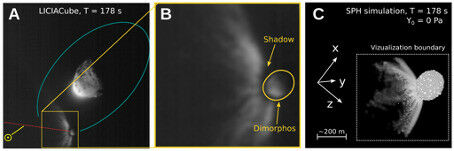
Observation and simulation of DART’s impact on Dimorphos. (A, B) This high-resolution image of Dimorphos and impact ejecta, at 178 seconds after DART’s impact, was taken by the Italian spacecraft LICIACube and is compared with our simulation (C) of the DART impact into a cohesionless (Y0= 0 Pa), rubble-pile target, at the equivalent time.
Observation and simulation of DART's impact on Dimorphos. (A, B) This high-resolution image of Dimorphos and impact ejecta, at 178 seconds after DART's impact, was taken by the Italian spacecraft LICIACube and is compared with our simulation (C) of the DART impact into a cohesionless (Y0= 0 Pa), rubble-pile target, at the equivalent time. Thanks to simulations with a software system developed at the University of Bern, an international team under Bernese leadership has provided important insights into the impact of NASA's DART space probe on the asteroid Dimorphos: it is very likely that not just a crater was created, but the entire asteroid was reshaped. The ESA space probe Hera, which is currently being prepared for its journey to Dimorphos, will bring certainty. The simulations will also provide valuable insights for the defense of planet Earth. ESA's Hera spacecraft for planetary defence is being prepared for a journey to the distant asteroid moon Dimorphos orbiting around its parent body Didymos. One of the first features Hera will look for is the crater left on Dimorphos by its predecessor mission DART, which impacted the asteroid to deflect its orbit.
TO READ THIS ARTICLE, CREATE YOUR ACCOUNT
And extend your reading, free of charge and with no commitment.