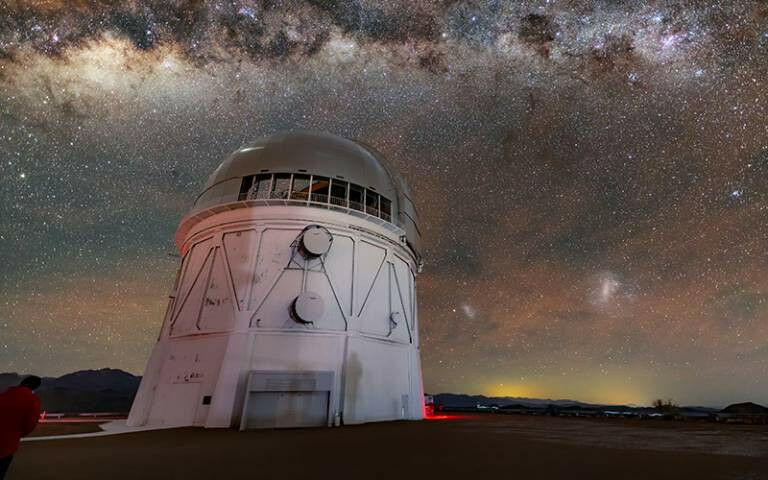
the Víctor M. Blanco 4-meter Telescope
the Víctor M. Blanco 4-meter Telescope The Dark Energy Survey (DES) collaboration involving UCL researchers has achieved one of the most robust measurements of the constraints on the universe's expansion to date. The international group of researchers, led by the U.S. Department of Energy's Fermi National Accelerator Laboratory (Fermilab), analysed nearly 1,500 supernovae using machine learning techniques. The culmination of two decades' work, the findings provide pivotal new support for the standard model of a universe with an accelerated expansion and mark a historic contribution to our understanding of the cosmos. In 1998, astrophysicists discovered that the universe is expanding at an accelerating rate, attributed to a mysterious entity called dark energy that makes up about 70% of our universe at present. The discovery was achieved by observing exploding stars called type Ia supernovae, which are a useful constant for scientists because they all have approximately the same brightness. Now, for its latest study and the final study of the DES Supernova Working Group, the DES collaboration has adapted this same technique to probe the mysteries of dark energy and the expansion of the universe further than ever before. Since beginning operations in 2012, the DES collaboration has mapped an area almost one-eighth the entire sky using a specially constructed 'Dark Energy Camera' at the US National Science Foundation's Cerro Tololo Inter-American Observatory in Chile.
TO READ THIS ARTICLE, CREATE YOUR ACCOUNT
And extend your reading, free of charge and with no commitment.