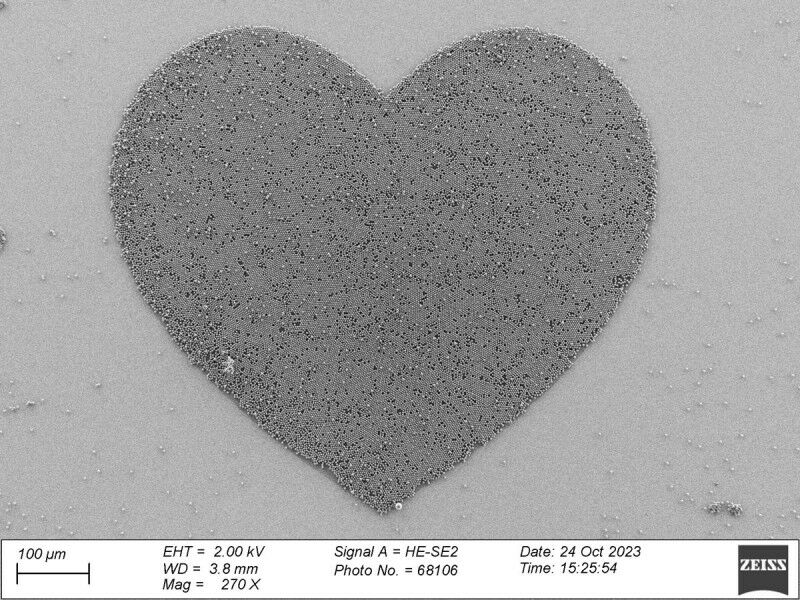
 SEM image of microparticles controlledly printed in the shape of a heart icon. The scale is 100 µm, which is a hair thickness.
SEM image of microparticles controlledly printed in the shape of a heart icon. The scale is 100 µm, which is a hair thickness. Ignaas Jimidar Researchers from the Department of Chemical Engineering at the Vrije Universiteit Brussel, Riga Technical University and the MESA+ Institute at the University of Twente have succeeded in arranging very small particles (10 µm to 500 nm, 10 to 100 times thinner than a human hair) in a thin layer without using solvents. This is a hugely important first step towards developing a new generation of sensors and electronics for a wide range of applications "Common methods based on crystallising solutions are not as versatile as we would like. What's more, previous dry methods were mainly effective on sticky surfaces, which limited their applications," says Ignaas Jimidar of the VUB. To address this issue, the team devised a method of attaching the particles on hard and non-sticky surfaces. They rubbed the particles across the surface by hand, and within about 20 seconds achieved a single layer of densely packed particles arranged in a hexagonal pattern.
TO READ THIS ARTICLE, CREATE YOUR ACCOUNT
And extend your reading, free of charge and with no commitment.
Your Benefits
- Access to all content
- Receive newsmails for news and jobs
- Post ads






