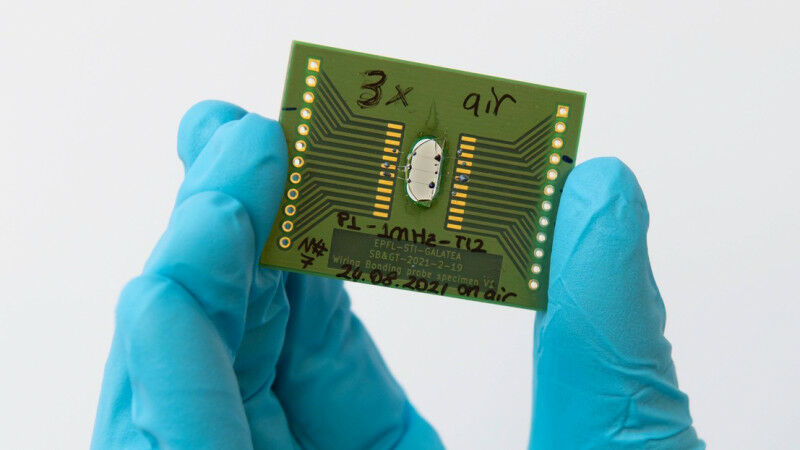
© 2024 EPFL / Lisa Ackermann Physicists propose a novel way to create photoconductive circuits, where the circuit is directly patterned onto a glass surface with femtosecond laser light. The new technology may one day be useful for harvesting energy, while remaining transparent to light and using a single material. What happens when you expose tellurite glass to femtosecond laser light? That's the question that Gözden Torun at the Galatea Lab, in a collaboration with Tokyo Tech scientists, aimed to answer in her thesis work when she made the discovery that may one day turn windows into single material light-harvesting and sensing devices. The results are published in PR Applied . Interested in how the atoms in the tellurite glass would reorganize when exposed to fast pulses of high energy femtosecond laser light, the scientists stumbled upon the formation of nanoscale tellurium and tellurium oxide crystals , both semiconducting materials etched into the glass, precisely where the glass had been exposed. That was the eureka moment for the scientists, since a semiconducting material exposed to daylight may lead to the generation of electricity. "Tellurium being semiconducting, based on this finding we wondered if it would be possible to write durable patterns on the tellurite glass surface that could reliably induce electricity when exposed to light, and the answer is yes," explains Yves Bellouard who runs EPFL's Galatea Laboratory.
TO READ THIS ARTICLE, CREATE YOUR ACCOUNT
And extend your reading, free of charge and with no commitment.
Your Benefits
- Access to all content
- Receive newsmails for news and jobs
- Post ads