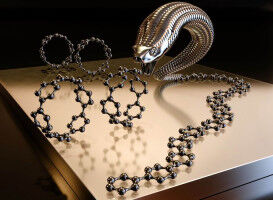
HU researchers develop light-driven nano-motor and use it to produce ring-shaped molecules that are intertwined like links in a chain.
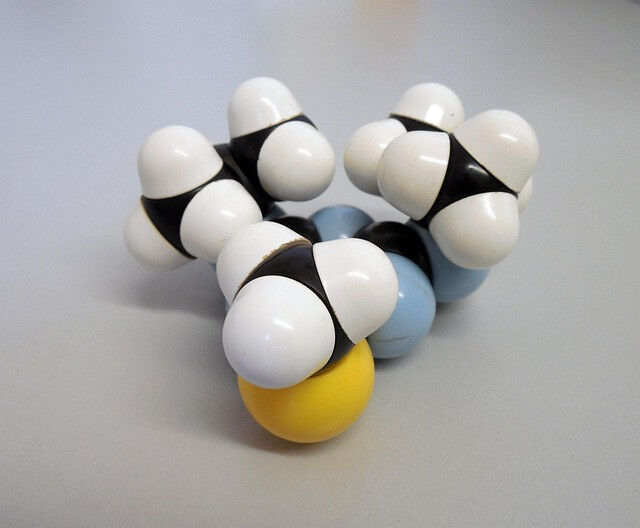
Berlin, July 31, 2025 - Threads and ropes are ideal for braiding, knotting and weaving. In chemistry, on the other hand, such processing of molecular strands is an almost impossible challenge. This is because molecules are not only tiny, they are constantly in motion and therefore cannot be easily touched, held or specifically shaped.
A research group at the Institute of Chemistry at Humboldt-Universität zu Berlin (HU), led by Michael Kathan, has now succeeded in wrapping two strands of molecules around each other using an artificial, light-driven nano-motor, thereby creating a particularly complex structure: a catenane (from the Latin "catena" = chain). Catenanes consist of two ring-shaped molecules that are intertwined like links in a chain - without being chemically connected to each other. The research results were published in the journal Science .
Nano-motor brings a new kind of mechanical control to the world of molecules
"What we have developed is basically a mini-machine that is driven by light and rotates in one direction," says Michael Kathan. we use this controlled movement to mechanically wrap two strands of molecules around each other and connect them - regardless of whether they would do this on their own or not. For the first time, our motor brings a kind of mechanical control to the world of molecules that we previously only knew from the macroscopic world."
New process can generate a variety of specific three-dimensional structures
In synthetic chemistry, it has hardly been possible to intertwine molecules in a targeted manner, especially when this arrangement contradicts the natural process of self-organization of molecules. In nature, molecules are constantly in motion and can assemble into three-dimensional structures in this process. Building blocks of cells such as proteins or the genetic molecule DNA are assembled in this way. However, these are generally not solid and permanent structures. For this reason, so-called templates have often been used in the laboratory - molecular templates that provide specific structures but only work with certain molecules. The new method takes a different approach: the artificial molecular machine can force a large number of molecules into a wide variety of three-dimensional structures. Driven by light, the rotating motor generates a mechanically defined coil with each step, which is then chemically fixed. The movement is directed and programmable. "Our method is the first template-free approach that allows such precise mechanical control, and it is also easy to generalize," says Michael Kathan.
New possibilities for the design of innovative materials
The catenanes synthesized in the laboratory using the new method are considered the basic building blocks for mechanically entangled structures such as molecular chains, tissues or networks. The study now presented shows for the first time that such structures can in principle be produced from very different molecules. The study thus provides a fundamental and generalizable conceptual approach: complex, mechanically defined architectures are technically feasible at the molecular level. This fundamentally expands the current scope of chemical synthesis and opens up the possibility of designing entire materials specifically from mechanically entangled molecules in the future. Such materials would have special properties: due to their molecular structure, they would be highly flexible and at the same time highly resistant.
Image for download
Link to the homepage of the research group