The US research center for particle physics "Fermilab" recently published the results of a groundbreaking experiment with muons - particles that play a central role in the so-called standard model of particle physics - for the third time. At the same time, a new study on complex theoretical calculations of the so-called magnetic dipole moment of the muon was published under the leadership of researchers from the University of Bern. The comparison of the theoretical calculations with the experimental results confirms the standard model of particle physics, but at the same time shows that the theory needs to be further improved.
The standard model of particle physics describes the basic building blocks of the universe - the smallest particles that make up everything - and the forces that hold these particles together. It is the basis for our understanding of how the universe works, from the tiny particles in atoms to the huge structures in space. Although it has been very successful so far, scientists suspect that the model does not yet explain all the secrets of the universe. It is therefore essential to test it with the utmost precision.
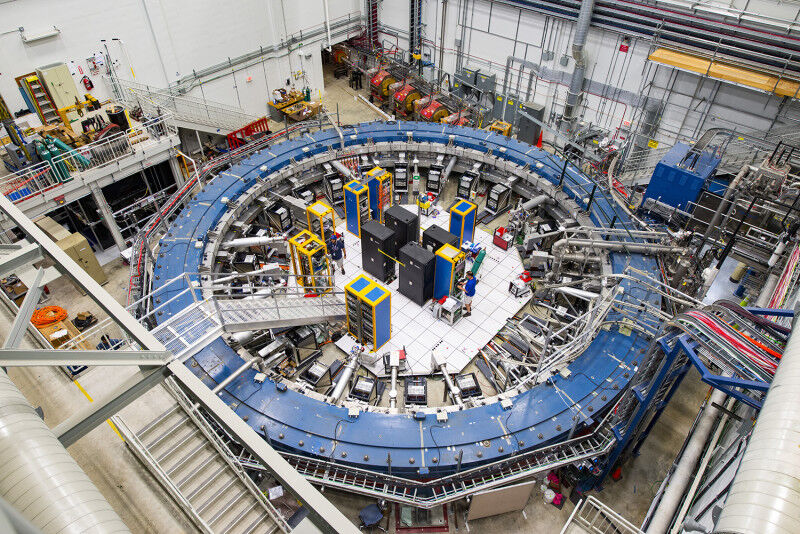
An important test for this is an experiment at the US research center for particle physics ’Fermilab’, which measures a special property of the particle muon: the so-called anomalous magnetic dipole moment. It describes how the muon reacts to magnetic fields. The experiment at Fermilab recently provided the third and last high-precision experimental measurement of the muon’s anomalous magnetic dipole moment. 2017 also saw the founding of the ’Muon g-2 Theory Initiative’, an international research collaboration that deals with the theoretical calculation of the muon’s anomalous magnetic dipole moment. As members of the Muon g-2 Theory Initiative, researchers from the Albert Einstein Center for Fundamental Physics and the Institute for Theoretical Physics (ITP) at the University of Bern have developed the theoretical calculation of the anomalous magnetic dipole moment of the muon within the framework of the standard model in parallel with the experiment at Fermilab.
Why the muon is an exciting particle
The elementary particle muon has a magnetic moment whose strength in relation to its spin is described by the so-called gyromagnetic ratio ’g’. As a first approximation, this value of g for the muon is 2. However, precise experimental measurements carried out around seventy years ago showed that the exact value deviates slightly - in the per mille range - from 2. The deviation of g from 2, i.e. ’g-2’, is the so-called anomalous magnetic dipole moment.
’The anomalous magnetic dipole moment has been measured with increasing accuracy in recent decades,’ says Gilberto Colangelo, Director of the Albert Einstein Center and the Institute for Theoretical Physics at the University of Bern and member of the Steering Committee of the Muon g-2 Theory Initiative. ’The experimental measurements also gain their great significance from the fact that g-2 can also be calculated theoretically with high accuracy and the experimental and theoretical results can be compared with each other,’ Colangelo continues. ’A discrepancy between theory and experiment would be a clear indication that the standard model of particle physics needs to be extended - for example with new, previously unknown particles,’ explains Colangelo.
Low probability of discovering new particles
’The theoretical calculation of g-2 in the standard model is very complex. Progress has been made over the last seventy years through the meticulous work of many theorists,’ says Martin Hoferichter, Professor of Theoretical Physics at the University of Bern and also a member of the initiative’s steering committee.
In 2020, the initiative published its first more precise theoretical value. This was calculated using data from particle experiments from around the world for so-called electron-positron scattering. ’The comparison of this calculated value with previous experimental measurements showed a deviation,’ says Hoferichter. When Fermilab presented its first results in 2021, a new theoretical prediction of the value for g-2 was also published by the ’Budapest-Marseille-Wuppertal Collaboration’ - an international research group (see the report in the journal Physics Reports ). This calculation was based on a technique that solves the underlying theory by numerical simulations on supercomputers and no longer requires data from the electron-positron experiments. ’The comparison of the experimental and the new theoretical results showed a smaller deviation in this case, consistent with the accuracy achieved,’ explains Hoferichter.
The results of the most recent and last measurement in the ’muon g-2 experiment’ at Fermilab are consistent with the results from 2021 and 2023. However, at 0.127 ppm (parts per million, unit for the accuracy of measurements), they show significantly better accuracy. The latest measurement is based on all data from the last six years of the experiment at Fermilab. The collaboration was thus able to achieve its precision target proposed in 2012, a measurement with an accuracy of 0.14 ppm. In parallel to the experimental measurements at Fermilab, the ’Muon g-2 Theory Initiative’ has now published a new theoretical calculation of the anomalous magnetic dipole moment of the muon. ’The calculations are again based on the technique that relies on numerical simulations,’ explains Urs Wenger, Professor at the Institute of Theoretical Physics and co-author of the report on the theoretical calculation. ’The recently determined theoretical value for g-2 shows greater agreement with the experimentally measured value at Fermilab. This observation supports the standard model of particle physics and reduces the probability that new, previously unknown particles or forces will be discovered in the near future,’ Wenger continues.
Further calculations and experiments on the horizon
Future experiments, such as the one planned at the Japan Proton Accelerator Research Complex - an international research center in Japan dedicated to the study of the foundations of matter - will make further measurements of the muon’s anomalous magnetic dipole moment.
’In parallel, the ’Muon g-2 Theory’ will continue to refine theoretical calculations and try to resolve the inconsistencies between the different methods. This is all the more important because at the moment the experimental precision is four times better than that of the theoretical calculation. This means that the sensitivity to new particles beyond the standard model can be improved accordingly as soon as the theoretical precision corresponds to the precision now achieved experimentally. This will require improved numerical simulations, new experiments for electron-positron scattering and additional complementary methods, such as so-called tau decays or the MUonE project, which is currently in preparation at CERN near Geneva, the European Organization for Nuclear Research,’ concludes Colangelo.