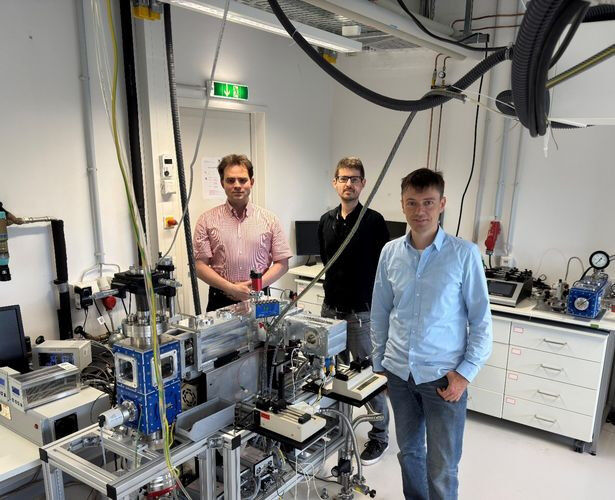
For the past five years, researchers at Leipzig University have been working on fundamentally new methods to specifically assemble gaseous, charged molecular fragments into new, complex molecules. The newly synthesized substances are deposited on surfaces. This innovative process opens up new perspectives for applications in modern nanoelectronics and sensor technology. It also offers new research approaches in various scientific disciplines, ranging from catalyst research to medical applications. The scientists from Leipzig University and their cooperation partners from Purdue University (USA) have published a summary of the research results from the past five years in the journal "Nature Reviews Chemistry".
up to now, charged molecular fragments have mainly been studied in analytical chemistry to determine the structure of molecules. However, research in recent years has shown that these molecular fragments are also of great importance for synthetic applications. Through their controlled deposition on surfaces, chemical reactions can be initiated that would not be possible with conventional synthesis methods," explains research group leader Jonas Warneke from the Wilhelm Ostwald Institute for Physical and Theoretical Chemistry at Leipzig University.
The research instruments used, which have been specially optimized for so-called thin-film syntheses with charged molecular fragments, only exist at two locations worldwide. They were developed jointly by the research groups led by Professor Warneke and Julia Laskin from Purdue University. Thin film synthesis refers to the production of thin films with thicknesses in the nanometer to micrometer range.
Long history of research in Leipzig
In the article, the Leipzig research team reports on its work on controlled chemical bond formation with "aggressive" molecular fragments. The most chemically reactive, negatively charged molecular fragment known to date, which has a long history of research in Leipzig, could be specifically bound to other molecules. For example, nitrogen from the air, which is considered to be less reactive, was also bound in layers on surfaces. This opens up new possibilities for using such less reactive chemical raw materials to synthesize new molecules and functional materials on surfaces or to specifically change the properties of material surfaces.
In the article, the Purdue University research team describes its work on linking metal-containing, charged "nanoclusters" (small particles with a precisely defined number of atoms), which are of interest for quantum technologies due to their special magnetic and electronic properties. In addition, the joint work of the two research groups on the development of the instruments and the reaction of molecular, charged catalysts on surfaces will be reported on.
"In the coming years, we would like to optimize our work by developing even more powerful instruments for thin-film synthesis with molecular fragments," says Warneke. This could enable the synthesis of materials on a microscale and pave the way for applications of the extraordinary new compounds assembled from molecular fragments in microsystems technology. In addition, the Leipzig research team is developing new ways to analyze large biomolecules on surfaces by attaching charged molecular fragments, which could be important for the fundamental understanding of the biological functions of these molecules on cell surfaces.
Original title of the publication in "Nature Reviews Chemistry":
,, Molecular synthesis with gaseous fragment ions on surfaces ", doi: 10.1038/s41570-025-00719-1