


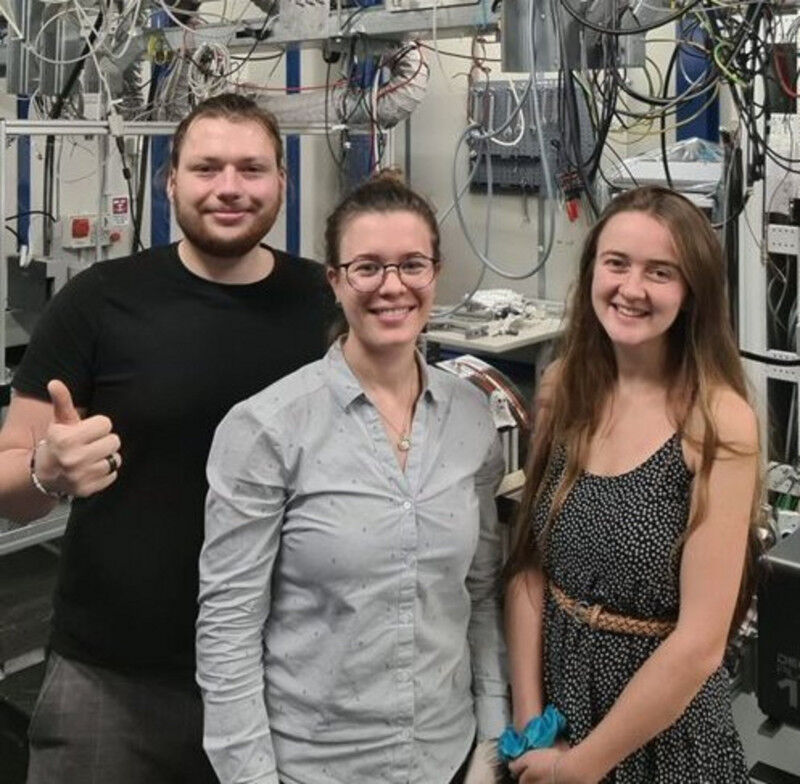
Synchrotron radiation provides insight into the interior of modern energy storage devices: researchers at Montanuniversität Leoben have used synchrotron radiation to uncover a central interaction in supercapacitors and precisely describe its influence on the transport of charge carriers during operation - a finding that paves the way for more powerful energy storage devices and could even contribute to the removal of perpetual chemicals from water. The electrode material used consisted of the material class of metal-organic frameworks (MOFs), for the development of which the Nobel Prize in Chemistry was awarded this year.
Understanding the energy storage of the future in detail
The energy transition needs storage technologies that are fast, efficient, sustainable and durable. Supercapacitors meet many of these requirements: They charge in seconds, withstand millions of charging cycles and manage entirely without scarce raw materials. However, their inner workings are a complex puzzle that has so far only been partially understood. Research from Leoben has now added an important piece to this puzzle.
The work was carried out as part of first author Malina Seyffertitz’s dissertation at the Department of Physics at the University of Leoben in cooperation with the renowned Cambridge University in England. "We wanted to understand in detail what happens inside a supercapacitor during charging and discharging and how the ions behave as charge carriers in the nanometer-sized pores of the electrodes," explains supervisor Prof. Oskar Paris.
Clear view thanks to synchrotron radiation and model material
In order to investigate the movements of the ions in the electrodes "operando" (i.e. in real time), the team used ultra-brilliant X-ray radiation at three major European research facilities in Trieste, Grenoble and Hamburg. The experimental platform developed and now established in Leoben can also be transferred to other electrochemical systems in the future.
The model material used for the electrodes was this year’s "Nobel Prize in Chemistry material", namely metal-organic frameworks (MOFs), which were synthesized by the cooperation partners in Cambridge. The highly ordered structure of the MOFs facilitates the evaluation and interpretation of the data and allows direct conclusions to be drawn about the underlying mechanisms of complex energy storage.
Central discovery: tightly bound anions
With the combination of tailor-made material and state-of-the-art measurement technology, the charging and discharging process could be tracked at the atomic level in real time. The measurements show: Fluorine-containing anions bind tightly to nitrogen-containing groups within the tiny MOF pores. These "anchored" particles remain immobile even when the voltage changes, leaving the remaining mobile cations to do all the charge balancing. For the first time, this also directly explains why these systems are often cation-dominated and how the charge mechanism can be specifically influenced.
From model material to application
This deeper understanding of ion movement provides a valuable basis for developing supercapacitors in a more targeted manner. The Leoben team is already working on transferring the observed mechanisms to sustainable and more cost-effective carbon materials.
In addition, the specific interactions found could open up new perspectives for environmental applications, for example in the targeted removal of long-lasting pollutants such as PFAS ("perpetual chemicals") from water.
The interdisciplinary study was carried out in collaboration between the Chair of Physics and the Department of Materials Science at the University of Leoben, as well as the University of Cambridge and Graz University of Technology. The data was measured at the synchrotron radiation sources ELETTRA in Trieste, ESRF in Grenoble and PETRA III in Hamburg. The work was published in Nature Communications and is available online at: https://doi.org/10.1038/s41467-025-63772-w

