Disrupting copper homeostasis with small molecules
Copper ions are essential to life, as many enzymes require copper to function. For example, without copper ions, our bodies would not be able to convert food into energy. However, too much copper is often toxic. For this reason, cells and organisms carefully maintain constant copper levels, notably by storing excess copper in specific compartments. Molecules capable of disrupting this storage system by transporting copper ions out of these compartments can thus induce toxicity, which can be exploited to destroy cancer cells.Cuphoralix, a copper transporter
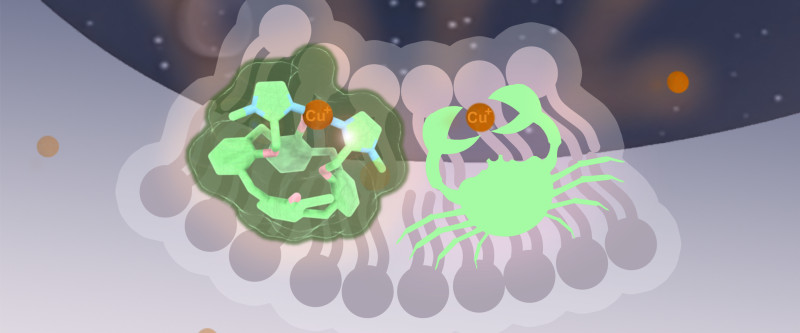
Inspired by the copper coordination motifs found in proteins, ULB researchers have developed "crab-like" molecules with two coordination arms capable of efficiently binding copper ions carrying a single positive charge (Cu+). This is crucial, as the majority of copper ions inside cells are monocharged, whereas most molecules described in the literature only bind dicharged copper ions (Cu²+). In addition, the researchers had to optimize the molecule’s ability to insert itself into the lipid membrane so that it could function as a transmembrane transporter and be effective in cells. The best-performing molecule was named Cuphoralix, in reference to its copper ionophore function based on a c’alix arene macrocycle.Interdisciplinary collaboration
Over the past eight years, Hennie Valkenier (Engineering of Molecular NanoSystems, EPB) and Ivan Jabin (Organic Chemistry Laboratory, Faculty of Science) and their teams have been working on the synthesis of a series of small molecules designed to transport copper ions across cell membranes. Copper transport by these molecules was first studied in model liposomes, using fluorescent probes sensitive to copper ions. They were then tested on yeast cells with Anna Marini and Mélanie Boeckstaens (Laboratory of Membrane Transport Biology, Faculty of Science), demonstrating their efficiency not only in model systems, but also in the membranes of living cells.Studies on cancer cells were carried out by Aurélien Deniaud and his colleagues at the Université Grenoble Alpes (UGA), who demonstrated highly toxic effects on cancer cells. Advanced studies carried out at the European Synchrotron Radiation Facility (ESRF) in Grenoble tracked the distribution of copper within cells, demonstrating that Cuphoralix acts as a copper transporter and redistributes copper ions within liver cells, resulting in toxicity.
This work has been patented by ULB and UGA, and the results published in the Journal of the American Chemical Society.