

Life Sciences - Mar 13
New DNA tools outperform traditional methods for detecting genetic risk in wildlife
New DNA tools outperform traditional methods for detecting genetic risk in wildlife
Health - Mar 13
Oxford and Serum Institute of India sign IP license agreement to advance NipahB vaccine candidate
Oxford and Serum Institute of India sign IP license agreement to advance NipahB vaccine candidate
Life Sciences - Mar 13
How the brain creates meaning: Martin Vinck investigates the key to thoughts, attention and consciousness
How the brain creates meaning: Martin Vinck investigates the key to thoughts, attention and consciousness





Career - Mar 12
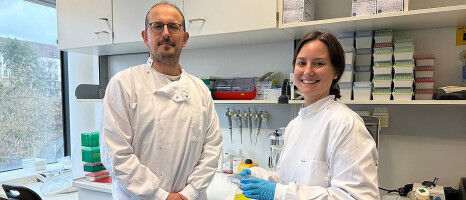
Women often need stronger professional networks to climb corporate ladder, Western analysis shows
Women often need stronger professional networks to climb corporate ladder, Western analysis shows
Environment - Mar 12
Turning dairy emissions into opportunities: how climate finance can drive climate-smart dairy
Turning dairy emissions into opportunities: how climate finance can drive climate-smart dairy
Health - Mar 12
Longer pollen seasons set to make allergies a major public health issue in coming decades
Longer pollen seasons set to make allergies a major public health issue in coming decades
Health - Mar 12
Nuffield Department of Primary Care Health Sciences designated as the WHO Collaborating Centre on Primary Health Care
Nuffield Department of Primary Care Health Sciences designated as the WHO Collaborating Centre on Primary Health Care
Innovation - Mar 12
Secure communication for automated vehicles - Thüringer Innovationszentrum Mobilität launches new research group
Secure communication for automated vehicles - Thüringer Innovationszentrum Mobilität launches new research group
Economics - Mar 12
Visions of the Brussels economy. An empirical analysis of convergences and divergences
Visions of the Brussels economy. An empirical analysis of convergences and divergences
History & Archeology - Mar 12
Record-breaking trove of information: Upper Egypt site has now yielded over 43,000 inscribed pot sherds
Record-breaking trove of information: Upper Egypt site has now yielded over 43,000 inscribed pot sherds
news
History & Archeology
Results 21 - 40 of 979.
History & Archeology - Architecture & Buildings - 23.10.2025

Since 2017, the Centre de Recherche en Archéologie et Patrimoine (CReA-Patrimoine) has been exploring Brussels' Grand-Place and its surroundings. The aim: to understand how this central location of the city was built and transformed between the second Middle Ages and the end of the modern era. Here's a look back at these unusual excavations in one of the world's most beautiful squares.
History & Archeology - Environment - 16.10.2025

Archaeology A research team led by the University of Copenhagen has uncovered a remarkable Early Bronze Age ceremonial gathering place at Murayghat in Jordan. The discovery may shed new light on how ancient societies responded to social and environmental upheaval. How did ancient cultures react to severe crises and the breakdown of the established social order? The 5,500-year-old bronze age site of Murayghat in Jordan, excavated by archaeologists from the University of Copenhagen, may hold an answer.
History & Archeology - Social Sciences - 07.10.2025
Ancient teeth provide new insight into the lives of the world’s first farming villagers
Archaeologists have revealed new insights into how the world's first farming villagers formed communities, moved across the land and responded to outsiders. Researchers analysed the chemical signatures in teeth from 71 people, spanning the entire Neolithic period from 11,600 to 7,500 years ago. The teeth were found at five archaeological sites in what is now modern Syria.
History & Archeology - 07.10.2025
Europe’s oldest blue pigment found in Germany
In a ground-breaking discovery that illuminates new insights into the early prehistoric origins of art and creativity, a new study led by re-searchers from Aarhus University have identified the earliest known use of blue pigment in Europe. by Mette Gjanderup Heilskov In a ground-breaking discovery that illuminates new insights into the early prehistoric origins of art and creativity, a new study led by researchers from Aarhus University have identified the earliest known use of blue pigment in Europe.
History & Archeology - 06.10.2025

Mesoamerica Christophe Helmke and Magnus Pharao Hansen have taken the first steps toward solving a major archaeological mystery surrounding the ancient Mexican city of Teotihuacan. Until now, the language of Teotihuacan has been unknown. More than two millennia ago, Teotihuacan was a thriving metropolis in central Mexico with up to 125,000 inhabitants.
Environment - History & Archeology - 03.10.2025
Analysis: 12,000-year-old rock art marked ancient water sources in Arabia’s desert
Around 12,000 years ago, hunter-gatherers in what is now Saudi Arabia created detailed, life-sized rock carvings of camels and other animals on cliffs. Here researchers, including Dr Ceri Shipton (UCL Archaeology), explore what this means for history and archaeology. About 12,000 years ago, high up on a cliff in the desert of northern Arabia, an artist - or perhaps artists - was hard at work.
History & Archeology - Environment - 30.09.2025
Ancient giant stone carvings pointed out water sources in ancient Arabia
Recently discovered, life-sized figures of camels carved prominently onto cliff faces in the northern region of the Arabian Peninsula were likely used to mark routes to water sources in the vast Nafud desert nearly 12,000 years ago, finds a new study involving UCL researchers. The paper, published in Nature Communications , found that these stone-age carvings indicate that humans settled in the region at a time when seasonal water sources were starting to return at the beginning of the Holocene following the dry conditions of the last ice age.
History & Archeology - Environment - 29.09.2025
Earliest archaeological evidence of blue indigo dye found on 34,000-year-old grinding tools
New research has found the earliest evidence of the use of blue dye in the archaeological record, dating back over 34,000 years. The study shows that prehistoric people at Dzudzuana Cave in Georgia were using stone pebbles to grind the leaves of Isatis tinctoria , also known as dyers woad, a plant known today for producing indigo dye.
History & Archeology - Life Sciences - 26.09.2025
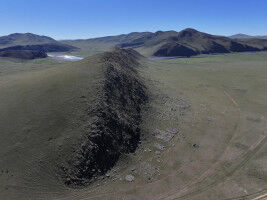
A new study combining archaeological and genetic research offers fresh insights into social organisation and population dynamics in the Late Bronze Age (approximately 1500 to 1000 BCE). Conducted by an international team of researchers-including scholars from the Leibniz-Zentrum für Archäologie (LEIZA) in Mainz and the University of Bonn, both in Germany-the study focuses on burial practices in Mongolia.
History & Archeology - Materials Science - 25.09.2025
Oldest hippopotamus ivory object in the Iberian Peninsula
The discovery opens up new perspectives for the study of exchange networks in the Mediterranean during the Copper Age. Archeology Researchers at the Prehistoric Studies and Research Seminar (SERP) of the University of Barcelona have identified the oldest piece made of hippopotamus ivory in the Iberian Peninsula.
History & Archeology - Paleontology - 23.09.2025

The oldest workshop for making shell jewellery has been unearthed at the Palaeolithic site of La Roche-à-Pierrot in Saint-Césaire, Charente-Maritime. Dating back at least 42,000 years and accompanied by red and yellow pigments, this unique assemblage in Western Europe has been linked to the Châtelperronian culture, which marks the transition between the last Neanderthals and the arrival of Homo sapiens in Europe.
History & Archeology - 17.09.2025
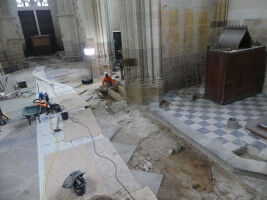
Since 2023, Inrap archaeologists have worked on several occasions in the Cathedral of Saint-Pierre et Saint-Paul in Nantes, as part of the project to restore the tomb of the Duke of Brittany François II and the Duchess Marguerite de Foix, and more generally as part of the cathedral's restoration program following the fire on July 18, 2020.
Social Sciences - History & Archeology - 16.09.2025
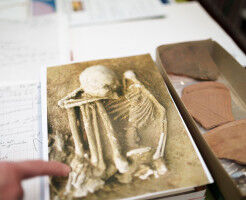
The earliest known evidence of mummification has been uncovered by archaeologists at The Australian National University (ANU), with the remains from burials at sites across southeastern Asia dating back more than 10,000 years. According to the researchers, it was common for ancient hunter-gatherer communities in China and Southeast Asia to honour the dead by folding and binding the body and hanging it over a smoky fire for a long period of time.
History & Archeology - Environment - 11.09.2025

Britain's industrial economy did not collapse when the Romans left and went on to enjoy a Viking-age industrial boom, a new study finds, undermining a stubborn 'Dark Ages' narrative. It has significant implications for our wider understanding of the end of Roman Britain Professor Martin Millett The Romans have long been credited with bringing industry to Britain involving large-scale lead and iron production.
Environment - History & Archeology - 04.09.2025
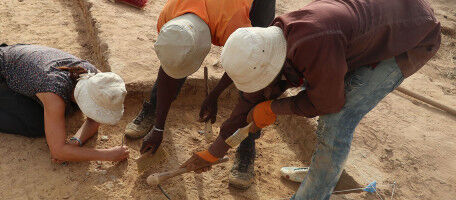
A team from the University of Geneva's discovery of a prehistoric workshop in Senegal sheds light on the little-known hunter-gatherer presence in West Africa. What do we know about the last hunter-gatherers who lived in West Africa? While these prehistoric populations have been extensively studied in Europe and Asia, their presence in this vast region - covering 6 million square kilometres, more than ten times the size of France - remains poorly documented.
Environment - History & Archeology - 02.09.2025

Since the Middle Ages, the size of wild and domestic animals has largely been shaped by human selection: domestic animals are increasingly larger; wild animals increasingly smaller. During the 7,000 years preceding this period, however, wild and domestic species evolved in a synchronous and similar manner, suggesting that environmental and climatic changes played a greater role in shaping animal morphology.
History & Archeology - Health - 26.08.2025

Researchers base calculations on six different methods and reach the same conclusion Life Expectancy: A recent study shows that life expectancy is no longer increasing as quickly for people born between 1939 and 2000. Researchers predict that these generations will not reach an average age of 100. Slower Increase: Life expectancy gains have slowed significantly, with increases of only two and a half to three and a half months per generation from 1939 to 2000, compared to five and a half months for earlier generations.
History & Archeology - Social Sciences - 25.08.2025

Pottery shards, coins, and bones can survive for millennia beneath the soil, but the scents of antiquity typically escape archaeological recovery. Now, for the first time, an interdisciplinary team of researchers has comprehensively analyzed the production, technology, and contents of 51 ceramic oil vessels from the Phoenician settlement of Motya, located on an island off the coast of Sicily.
Agronomy & Food Science - History & Archeology - 25.08.2025
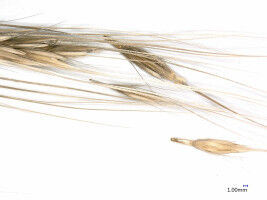
Early hunter and gatherers harvested wild barley in today-s southern Uzbekistan New discovery: A study reveals that people in southern Uzbekistan harvested wild barley at least 9,200 years ago, challenging previous beliefs about the origins of agriculture. These findings suggest that gathering wild plants was more widespread than previously thought.
History & Archeology - 22.08.2025

A Neolithic cow tooth discovered at Stonehenge dating back to its construction offers new evidence of the stone circle's Welsh origins, finds a new study involving UCL researchers. The paper, published in The Journal of Archaeological Science, examined a cow's jawbone that was discovered in 1924 beside Stonehenge's south entrance.


Life Sciences - Mar 13
New DNA tools outperform traditional methods for detecting genetic risk in wildlife
New DNA tools outperform traditional methods for detecting genetic risk in wildlife
Health - Mar 13
Oxford and Serum Institute of India sign IP license agreement to advance NipahB vaccine candidate
Oxford and Serum Institute of India sign IP license agreement to advance NipahB vaccine candidate
Life Sciences - Mar 13
How the brain creates meaning: Martin Vinck investigates the key to thoughts, attention and consciousness
How the brain creates meaning: Martin Vinck investigates the key to thoughts, attention and consciousness
Career - Mar 12
Women often need stronger professional networks to climb corporate ladder, Western analysis shows
Women often need stronger professional networks to climb corporate ladder, Western analysis shows
Environment - Mar 12
Turning dairy emissions into opportunities: how climate finance can drive climate-smart dairy
Turning dairy emissions into opportunities: how climate finance can drive climate-smart dairy
Health - Mar 12
Longer pollen seasons set to make allergies a major public health issue in coming decades
Longer pollen seasons set to make allergies a major public health issue in coming decades
Health - Mar 12
Nuffield Department of Primary Care Health Sciences designated as the WHO Collaborating Centre on Primary Health Care
Nuffield Department of Primary Care Health Sciences designated as the WHO Collaborating Centre on Primary Health Care
Innovation - Mar 12
Secure communication for automated vehicles - Thüringer Innovationszentrum Mobilität launches new research group
Secure communication for automated vehicles - Thüringer Innovationszentrum Mobilität launches new research group
Economics - Mar 12
Visions of the Brussels economy. An empirical analysis of convergences and divergences
Visions of the Brussels economy. An empirical analysis of convergences and divergences
History & Archeology - Mar 12
Record-breaking trove of information: Upper Egypt site has now yielded over 43,000 inscribed pot sherds
Record-breaking trove of information: Upper Egypt site has now yielded over 43,000 inscribed pot sherds