




Computer Science - Mar 18
SDU is part of global initiative to bring mathematical certainty to modern computing and artificial intelligence
SDU is part of global initiative to bring mathematical certainty to modern computing and artificial intelligence


Health - Mar 18
Bilingual forms improve cancer treatment understanding among people with limited English
Bilingual forms improve cancer treatment understanding among people with limited English






news
Paleontology
Results 21 - 40 of 323.
Life Sciences - Paleontology - 29.10.2025
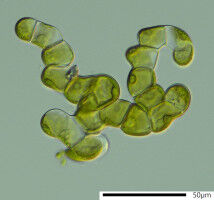
Research team led by Göttingen University study genetic evolution of alga Land plants - such as mosses, ferns and trees - are some of the most structurally complex photosynthesizing organisms on Earth. But their evolutionary story is deeply tied to their ancestors: simpler green algae that lived hundreds of millions of years ago.
Life Sciences - Paleontology - 01.10.2025
Fossil discovered in Scotland reveals new species of ’false snake’ reptile
A fossil discovered in Scotland has revealed a new species and family of Jurassic reptile linked to the origins of lizards and snakes, reports a study co-led by a UCL researcher. Published in Nature by an international team including researchers at UCL, the American Museum of Natural History, National Museums Scotland and colleagues in the UK, France and South Africa, the study describes a previously unknown Jurassic reptile that lived around 167 million years ago.
History & Archeology - Paleontology - 23.09.2025

The oldest workshop for making shell jewellery has been unearthed at the Palaeolithic site of La Roche-à-Pierrot in Saint-Césaire, Charente-Maritime. Dating back at least 42,000 years and accompanied by red and yellow pigments, this unique assemblage in Western Europe has been linked to the Châtelperronian culture, which marks the transition between the last Neanderthals and the arrival of Homo sapiens in Europe.
Paleontology - Life Sciences - 27.08.2025

Newly discovered fossils reveal that Spicomellus afer's skeleton was covered in spikes, some fused to the animal's skeleton, measuring as much as a metre long. The world's most unusual dinosaur is even stranger than first realised, as new research published in Nature reports that Spicomellus afer had a tail weapon more than 30 million years before any other ankylosaur, as well as a unique bony collar ringed with metre-long spikes sticking out from either side of its neck.
Paleontology - Life Sciences - 14.08.2025
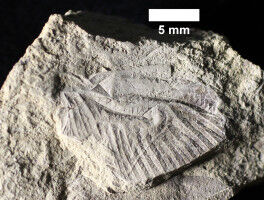
Finding sheds light on previously undocumented 30-million-year gap in the evolutionary history of dragonflies In a first for Canadian paleontology, a Cretaceous fossilized dragonfly wing, uncovered in Alberta's Dinosaur Provincial Park, has been identified as a new species.
Paleontology - Environment - 05.08.2025

New method reconstructs carbon dioxide levels and photosynthesis from fossilized tooth enamel A previously untapped source of data sheds new light on the climate of the early Earth: fossilized dinosaur teeth show that the atmosphere during the Mesozoic era, between 252 and 66 million years ago, contained far more carbon dioxide than it does today.
Paleontology - Life Sciences - 16.07.2025
Fossil discovery reveals ancient giant marine reptile relied on stealth while hunting in darkness
Left: Life reconstruction of the giant Jurassic ichthyosaur Temnodontosaurus, highlighting the winglike flipper and the unusual structures observed in the fin. Artwork by Joschua Knüppe. Right: Photograph of Drs Lomax and Lindgren, together with fellow researcher Sven Sachs, examining one part of the flipper at Lund University, Sweden.
Paleontology - 02.07.2025

An international research team has published a new study on one of the oldest known sites for the processing of animal meat by humans in the southern Balkans. At Marathousa 1, an archaeological site in the Greek Megalopolis Basin, researchers not only found numerous stone tools that provide clues to human behavior but also remains of the extinct straight-tusked elephant Palaeoloxodon antiquus.
Paleontology - Life Sciences - 26.06.2025

The Cambrian explosion was an extraordinary phenomenon in the evolution of life on the planet that led to the emergence of many animal phyla and the diversification of species. During this period, some 530 million years ago, most of the basic body plans of organisms that have survived to the present day emerged.
Environment - Paleontology - 24.06.2025

New study shows that humans were extensively using fire to alter the landscapes around them as early as 50,000 years ago Fire is an ancient natural phenomenon that has shaped our planet for more than 400 million years. It alters habitats, influences the carbon cycle, and is closely tied to changes in the climate and vegetation.
Life Sciences - Paleontology - 23.06.2025
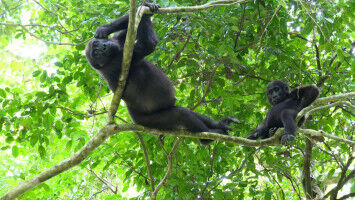
Researchers show that even large silverback gorillas spend a substantial amount of time in trees To the point Gorilla arboreality varies: The study shows that Bwindi mountain gorillas in Uganda and western lowland gorillas in Gabon spend significantly more time in the trees than the highly terrestrial Virunga mountain gorillas.
Paleontology - 11.06.2025

Paleontologists have identified a new species of dinosaur, named Khankhuuluu, which is the closest-known ancestor to the gigantic tyrannosaurs. The finding by an international team of researchers - led by Jared Voris and Darla Zelenitsky, PhD, in the Faculty of Science at the University of Calgary - has been published in the journal Nature .
Paleontology - Life Sciences - 26.05.2025

Paleontology - Earth Sciences - 20.05.2025

Team at Leibniz University Hannover and the University of Bonn more precisely pinpoints when flowering plants first appeared in earth's history. They are very tiny, but they are a key source of information when it comes to the earth's evolutionary history: pollen grains are usually no larger than 20 micrometres, or 0.02 millimetres.
Paleontology - 14.05.2025

Researchers uncover new evidence of how ancient human relatives in South Africa used their hands, revealing varying levels of dexterity and climbing ability To the point Different hand use: Two ancient human relatives, Australopithecus sediba and Homo naledi , had different finger bone morphologies that indicate they used different types of hand grips, both when using tools and when climbing Internal structure of the finger bones: A. sedi
Paleontology - 09.05.2025
500-million-year-old ancient fossil mystery solved by scientists
A new study led by our Earth Sciences department has made a surprising discovery about a mysterious fossil from the Cambrian period - over 500 million years ago. The fossil, Shishania aculeata , was originally thought to be an early mollusc, a group that includes snails and clams. But new research shows that it is actually a sponge-like animal known as a chancelloriid.
Paleontology - Environment - 07.05.2025

Western researchers uncover a ancient polar ecosystem - and surprising birthplace for familiar fish Most people picture the time of dinosaurs as a steamy, tropical world. But during the Late Cretaceous period, northern Alaska was a different kind of wild. Located far above the Arctic Circle, it endured months of winter darkness and freezing temperatures - even as much of the planet remained warm.
Paleontology - Life Sciences - 30.04.2025

Why do some ancient animals become fossils, while others vanish without a trace - A new study from the University of Lausanne reveals that the size and chemical composition of an animal are among the determining factors in its chances of surviving millions of years as a fossil, or vanishing without a trace.that an animal's size and chemical composition are among the determining factors in its chances of surviving millions of years as a fossil, or vanishing without a trace.
Paleontology - 30.04.2025

A small bone found 30 years ago at Dinosaur Cove in Victoria could change what we know about the evolution of two of Australia's most unique animals, the echidna and platypus. Until now, it was believed that both species of egg-laying monotremes descended from a land-dwelling ancestor, and while the platypus eventually became semiaquatic, the echidnas stayed on the land.
Paleontology - History & Archeology - 25.04.2025

An international research team led by the University of Tübingen's Dr. Márton Rabi has found that the giant crocodile Deinosuchus - often called the "terror crocodile" or "greater alligator" - was such a successful predator that it posed a threat even to large dinosaurs. Deinosuchus lived in the wetlands and coastal areas of North America in the Cretaceous period, 82 to 75 million years ago.


Computer Science - Mar 18
SDU is part of global initiative to bring mathematical certainty to modern computing and artificial intelligence
SDU is part of global initiative to bring mathematical certainty to modern computing and artificial intelligence
Health - Mar 18
Bilingual forms improve cancer treatment understanding among people with limited English
Bilingual forms improve cancer treatment understanding among people with limited English