

Environment - Today
UCalgary expedition, with NASA, Canadian and European space agencies, sets out to better understand state of Arctic ice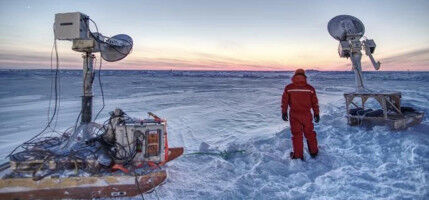
UCalgary expedition, with NASA, Canadian and European space agencies, sets out to better understand state of Arctic ice
Social Sciences - Mar 24
Young people's wellbeing is improving in Greater Manchester, major survey finds
Young people's wellbeing is improving in Greater Manchester, major survey finds

Environment - Mar 24
Australia's environment is improving but climate change is 'accelerating' damage to ecosystems and wildlife
Australia's environment is improving but climate change is 'accelerating' damage to ecosystems and wildlife

Psychology - Mar 23
The grief myth: it doesn't come in stages or follow a checklist - like love, it endures
The grief myth: it doesn't come in stages or follow a checklist - like love, it endures




History & Archeology - Mar 23
The UV has played a part in the discovery of a 3,500-year-old loom that sheds light on key aspects of the Bronze Age textile revolution
The UV has played a part in the discovery of a 3,500-year-old loom that sheds light on key aspects of the Bronze Age textile revolution
Innovation - Mar 23
The University of Valencia launches ClioViz, an open digital platform for accessing cultural heritage data
The University of Valencia launches ClioViz, an open digital platform for accessing cultural heritage data

Social Sciences - Mar 23
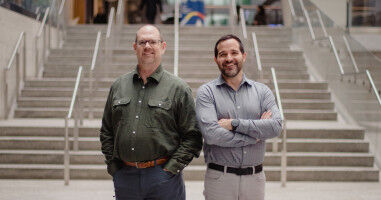
Study links higher concentration of pokie machines to increase in family and domestic violence
Study links higher concentration of pokie machines to increase in family and domestic violence
Health - Mar 23
Screening blitz could achieve cervical cancer elimination among Indigenous communities within a generation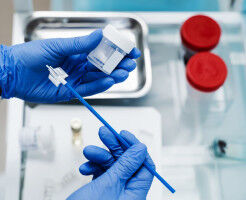
Screening blitz could achieve cervical cancer elimination among Indigenous communities within a generation

Computer Science - Mar 20
New computer chip material inspired by the human brain could slash AI energy use
New computer chip material inspired by the human brain could slash AI energy use
news
University College London
Results 1541 - 1560 of 2143.
Health - Life Sciences - 24.01.2018
Synthetic ’virus’ to kill bacteria
A synthetic 'virus' that kills bacteria on first contact has been developed by UCL and National Physical Laboratory researchers (NPL). The study, published , shows how newly designed proteins can be used to build tiny hollow shells that emulate the outer structures of naturally occurring viruses. The synthetic virus 'drones' recognise bacterial cells before targeting and destroying their most vulnerable part - their membrane.
Health - Life Sciences - 22.01.2018
Improving vaccines for the elderly by blocking inflammation
By identifying why skin immunity declines in old age, a UCL-led research team has found that an anti-inflammatory pill could help make vaccines more effective for elderly people. The study, published today in The Journal of Allergy and Clinical Immunology , found that an excessive inflammation reaction in older people can obstruct the immune system.
Health - Life Sciences - 22.01.2018
Onions could hold key to fighting antibiotic resistance
A type of onion could help the fight against antibiotic resistance in cases of tuberculosis, a UCL and Birkbeck-led study suggests. Researchers believe the antibacterial properties extracted from the Persian shallot could increase the effects of existing antibiotic treatment. The study, published in Scientific Reports , was led by Dr Sanjib Bhakta of Birkbeck, University of London and UCL's Professor Simon Gibbons , who worked with a team of scientists from Birkbeck, UCL, the University of Greenwich, the University of East London and Royal Free Hospital.
Health - Life Sciences - 22.01.2018
Epilepsy linked to brain volume and thickness differences
Epilepsy is associated with thickness and volume differences in the grey matter of several brain regions, according to new research led by UCL and the Keck School of Medicine of USC. The largest-ever neuroimaging study of people with epilepsy, published today in Brain , shows that epilepsy involves more widespread physical differences than previously assumed, even in types of epilepsy that are typically considered to be more benign if seizures are under control.
Career - Administration - 18.01.2018
Whitehall fails to fully exploit talents of non-exec directors, finds UCL study
Whitehall is failing to fully exploit the expertise of non-executive directors (NEDs) to improve the way departments' policies and plans are devised and implemented despite their high calibre, commitment and experience, a study by UCL's Constitution Unit has found. The study, which was led by Professor Robert Hazell, found civil servants "greatly valued" the advice and expertise of NEDs but that the non-executive directors themselves found the role frustrating and felt they could be much more effective if the system only allowed.
Health - Life Sciences - 16.01.2018
Statins are safe for children with abnormal cholesterol levels
Statins are safe for children living with genetically high cholesterol, according to new research from UCL, funded by the British Heart Foundation (BHF) and published in the Journal of Clinical Lipidology. The charity says the findings will 'reassure' parents of children with Familial Hypercholesterolaemia (FH) - an inherited condition that significantly increases the risk of a heart attack in their 40s, 30s or even 20s.
Health - Innovation - 12.01.2018
New technology for diagnosing immunity to Ebola
A promising new approach to detect immunity to Ebola virus infection has been developed by researchers from i-sense in a collaboration between UCL and Imperial College London. Published in ACS Nano , the new approach uses lateral flow technology, similar to that of a pregnancy test, coupled with smartphones to provide a promising alternative to lab-based testing.
Psychology - Health - 11.01.2018
Girls twice as likely to experience emotional problems as boys, reveals UCL study
Girls are more than twice as likely to experience emotional difficulties as boys, while boys are significantly more likely to experience behavioural problems, UCL research has revealed. In the first survey of its kind of more than 30,000 young people aged 11 to 14, UCL's Evidence Based Practice Unit and Anna Freud National Centre for Children and Families found 25% of girls said they had experienced emotional problems compared with 11% of boys.
Astronomy & Space - 10.01.2018
Data on 400 million astronomical objects released
Scientists on the Dark Energy Survey (DES), which includes UCL researchers, announce their first three years of data including information on about 400 million astronomical objects such as distant galaxies billions of light years away as well as stars in our own galaxy. DES scientists are using this data to learn more about dark energy, the mysterious force believed to be accelerating the expansion of the universe.
Health - Life Sciences - 22.12.2017
New marker in blood could detect fatal breast cancer up to one year earlier
A new marker that could be used to diagnose fatal breast cancer up to one year ahead of current methods has been identified in a study led by UCL. The study, published in Genome Medicine today, found that changes detected in a part of DNA which the researches named EFC#93 could suggest early signs of deadly breast cancer.
Physics - 21.12.2017
Increased physical fitness may offset cognitive deterioration in dementia
Physical fitness is associated with better cognitive performance in older adults with dementia, according to a new study from UCL. The positive effects were found to be independent of past levels of exercise and illness duration, suggesting it's never too late to benefit from good levels of physical fitness, even after the onset of dementia.
Health - Life Sciences - 18.12.2017
Dementia with Lewy bodies: unique genetic profile identified
Dementia with Lewy bodies has a unique genetic profile, distinct from those of Alzheimer's disease or Parkinson's disease, according to the first large-scale genetic study of this common type of dementia which was led by UCL. The genome-wide association study, conducted by a UCL-led collaboration of 65 academics in 11 countries and funded by Alzheimer's Society and the Lewy Body Society, is published today in The Lancet Neurology .
Life Sciences - Health - 14.12.2017
Gene mutation causes low sensitivity to pain
A UCL-led research team has identified a rare mutation that causes one family to have unusually low sensitivity to pain. The researchers hope the findings, published today in Brain , could be used to identify new treatments for chronic pain. They studied an Italian family, the Marsilis, which includes six people who have a distinctive pain response that has not been identified in any other people.
Health - Social Sciences - 08.12.2017
Heart disease linked to depression, loneliness, unemployment and poverty
Social stress factors such as loneliness and being unemployed, in addition to conventional risks such as smoking and high blood pressure, are associated with higher risks of developing heart disease, according to a new UCL-led study. The study, published by PLOS Medicine this week, analysed cohort data from three eastern European countries and found that heart disease incidence is more likely among people who rarely see their friends and relatives, are single, unemployed, less wealthy, and have depression-like symptoms.
Health - 06.12.2017
Psychosis incidence highly variable internationally
Rates of psychosis can be close to eight times higher in some regions compared to others, finds a new study led by researchers at UCL, King's College London and the University of Cambridge. The study, published today in JAMA Psychiatry , was the biggest international comparison of incidence of psychotic disorders, and the first major study of its kind in more than 25 years.
Astronomy & Space - 06.12.2017
Massive primordial galaxies found nestling in vast halo of dark matter
Two giant galaxies seen when the universe was only 780 million years old, or about 5% of its current age, have been identified by an international team involving UCL scientists using the Atacama Large Millimeter/submillimeter Array (ALMA). The latest observations push back the epoch of massive-galaxy formation and reveal that these uncommonly large galaxies are nestled inside an even larger cosmic structure, a halo of dark matter several trillion times bigger than the sun.
Social Sciences - Religions - 05.12.2017
Storytellers promoted co-operation among hunter-gatherers before advent of religion
Storytelling promoted co-operation in hunter-gatherers prior to the advent of organised religion, a new UCL study reveals. The research shows that hunter-gatherer storytellers were essential in promoting co-operative and egalitarian values before comparable mechanisms evolved in larger agricultural societies, such as moralising high-gods.
Agronomy & Food Science - 04.12.2017
Individual choices, not family influence teenagers’ non-alcoholic drink preference
Adolescents' non-alcoholic drinks preferences are strongly influenced by their own individual circumstances and lifestyle choices, but not by their families and home environment, according to a new UCL study. The study, published in Scientific Reports and funded by the Medical Research Council, is the first paper to establish the relative importance of genetic and environmental influences on liking for a range of common non-alcoholic beverages, in a large population-based sample of older adolescent twins.
Health - 01.12.2017
Rising levels of HIV drug resistance
HIV drug resistance is approaching and exceeding 10% in people living with HIV who are about to initiate or reinitiate first-line antiretroviral therapy, according to the largest meta-analysis to date on HIV drug resistance, led by researchers at UCL and the World Health Organization (WHO) and funded by the Bill & Melinda Gates Foundation and the WHO.
Life Sciences - Health - 30.11.2017
Behaviour not indicative of pain in stressed babies
In stressed newborn babies, behaviour alone is not a reliable way of assessing pain, according to new UCL and UCLH research. The study, published today in Current Biology and funded by the Medical Research Council UK, found that hospitalised newborns, who are already stressed by their environment have a much larger pain response in their brain following a routine clinical skin lance than non-stressed babies.


Environment - Today
UCalgary expedition, with NASA, Canadian and European space agencies, sets out to better understand state of Arctic ice
UCalgary expedition, with NASA, Canadian and European space agencies, sets out to better understand state of Arctic ice
Social Sciences - Mar 24
Young people's wellbeing is improving in Greater Manchester, major survey finds
Young people's wellbeing is improving in Greater Manchester, major survey finds
Environment - Mar 24
Australia's environment is improving but climate change is 'accelerating' damage to ecosystems and wildlife
Australia's environment is improving but climate change is 'accelerating' damage to ecosystems and wildlife
Psychology - Mar 23
The grief myth: it doesn't come in stages or follow a checklist - like love, it endures
The grief myth: it doesn't come in stages or follow a checklist - like love, it endures
History & Archeology - Mar 23
The UV has played a part in the discovery of a 3,500-year-old loom that sheds light on key aspects of the Bronze Age textile revolution
The UV has played a part in the discovery of a 3,500-year-old loom that sheds light on key aspects of the Bronze Age textile revolution
Innovation - Mar 23
The University of Valencia launches ClioViz, an open digital platform for accessing cultural heritage data
The University of Valencia launches ClioViz, an open digital platform for accessing cultural heritage data
Social Sciences - Mar 23
Study links higher concentration of pokie machines to increase in family and domestic violence
Study links higher concentration of pokie machines to increase in family and domestic violence
Health - Mar 23
Screening blitz could achieve cervical cancer elimination among Indigenous communities within a generation
Screening blitz could achieve cervical cancer elimination among Indigenous communities within a generation
Computer Science - Mar 20
New computer chip material inspired by the human brain could slash AI energy use
New computer chip material inspired by the human brain could slash AI energy use