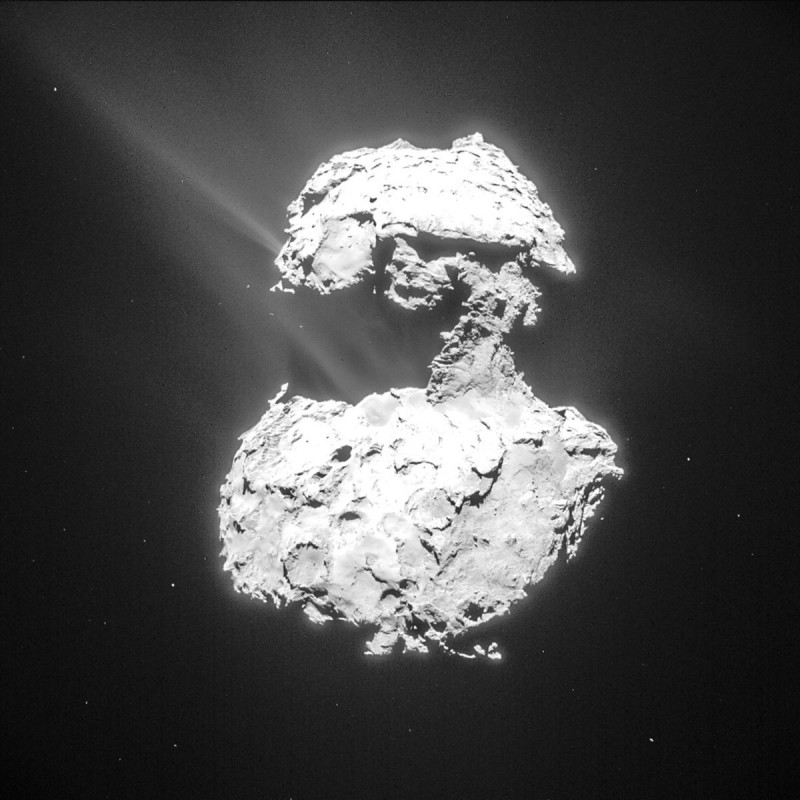
 Staub und Gas steigen von Churys Oberfläche auf, während sich der Komet dem sonnennächsten Punkt auf seiner Umlaufbahn nähert.
ESA's comet probe Rosetta has for the first time ever measured nitrogen gas at a comet, providing clues to the early stages of the formation of our solar system. The findings of the study, which was led by researchers at the University of Bern, have now been published in the journal «Science». MMolecular nitrogen, N2, is the major molecule in the atmosphere of Earth and is also present in the atmospheres and the surfaces of Pluto and Neptune's moon Triton. It also is thought to have been the dominant form of nitrogen in the early nebula from which our solar system emerged. Martin Rubin from the Physics Institute at the University of Bern and his team were now able to measure this 'most wanted molecule', as Rubin calls it, in the coma, the atmosphere, of comet 67P/Churyumov-Gerasimenko. It is for the first time ever that scientists were able to detect nitrogen molecules at a comet. 'Although some comets like ‹Chury› were probably formed in the same region as Triton and Pluto, until now we weren't able to find any molecular nitrogen in them', Rubin explains.
TO READ THIS ARTICLE, CREATE YOUR ACCOUNT
And extend your reading, free of charge and with no commitment.
Your Benefits
- Access to all content
- Receive newsmails for news and jobs
- Post ads