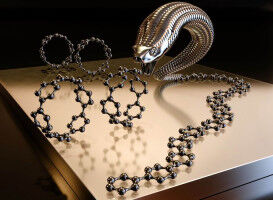
3D chemistry boosts perovskite efficiency to 23.9%
An international collaboration led by EPFL chemical engineers has overcome a problem in the manufacturing of perovskites that reduces their efficiency as solar panels. The approach produced perovskite solar panels with an efficiency of 23.9% and operational stability longer than 1000 hours. Perovskites are hybrid compounds made from metal halides and organic constituents, and show great potential in a range of applications, e.g. LED lights, lasers, and photodetectors. However, their major contribution is in solar cells, where they are poised to overtake the market and replace their silicon counterparts. Among the leading candidates for highly efficient and stable solar cells are lead iodide perovskites, which show excellent light-harvesting capabilities. However, their efficiency depends greatly on their manufacturing, and a key factor is removing defects from their light-harvesting surface. Passivation and perovskite efficiency The way this is typically done is with a method called "passivation", which coats the surface of perovskite films with chemicals (alkylammonium halides) to make them more resistant and stable.