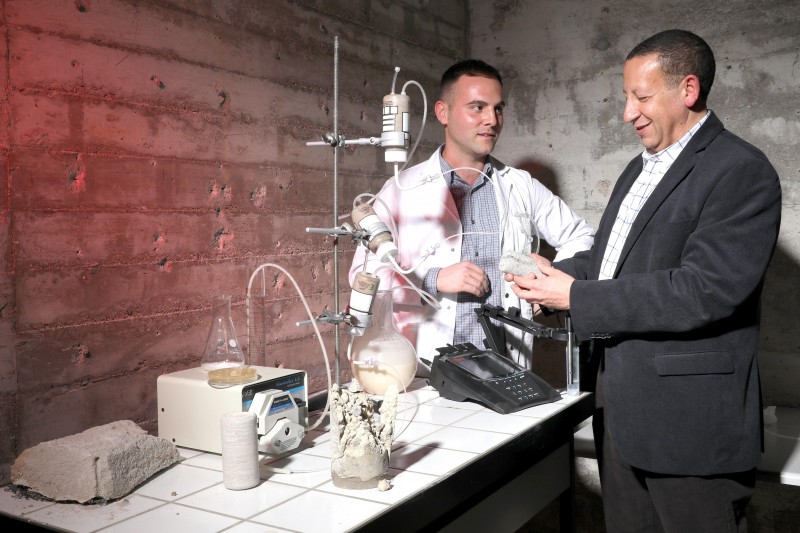
 Dimitrios Terzis et Lyesse Laloui testes their bacterial cement on different soils© 2018 Alain Herzog
EPFL's Laboratory of Soil Mechanics has developed an easily reproducible technique using bacteria and urea to reinforce sandy or gravelly terrain. A series of chemical reactions lead to the rapid formation of mineral crystals that bind the ground particles together. Much of the buildable land in urban areas is already in use. That which remains often needs to be stabilized and reinforced in order to minimize long-term environmental risks and the possibility of crack formation. Existing approaches to this problem include injecting concrete or putting down deep foundations, but these techniques are often impractical, unprofitable or environmentally undesirable. Dimitrios Terzis and Lyesse Laloui, two researchers at EPFL's Laboratory of Soil Mechanics (LMS), have come up with an organic, easy-to-use and low-cost solution that combines bacteria and urea. These two substances react to create calcite crystals, which firmly bind the gravel or sand particles together.
TO READ THIS ARTICLE, CREATE YOUR ACCOUNT
And extend your reading, free of charge and with no commitment.
Your Benefits
- Access to all content
- Receive newsmails for news and jobs
- Post ads