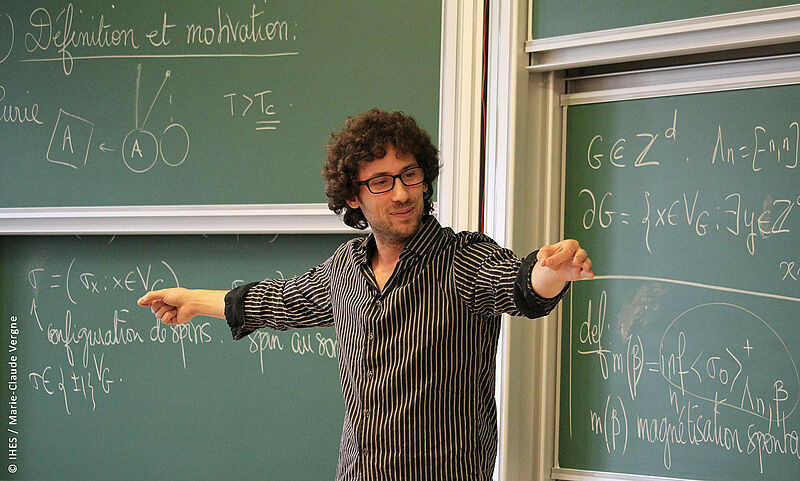
Photo (IHES, Marie-Claude Vergne): Prof. Hugo Duminil-Copin.
Interview with Prof. Hugo Duminil-Copin on the occasion of this year's Weierstrass Lecture. Photo (IHES, Marie-Claude Vergne): Prof. Hugo Duminil-Copin. Prof. Hugo Duminil-Copin, multiple award-winning mathematician and winner of the Fields Medal, is this year's keynote speaker at the Paderborn Weierstrass Lecture on May 12. In an interview, he explains what he is researching, what percolation models are all about and why he is so fascinated by phase transitions. You deal with the interface of probability theory, combinatorics and mathematical physics. What does that mean to a layperson? Duminil-Copin: Mathematical physics is the study of objects motivated by physics using mathematics. Concretely, my research work focuses on the mathematical study of phase transitions. I work on the brutal changes of matter like the transition from water to steam at 100 degrees of temperature. My objective is to understand and model mathematically this kind of transitions. Probability, which is nothing but the theory of random events, arrives naturally when doing mathematical physics. The complexity of our world forces us to model it using randomness. When it becomes impossible to exactly track the behavior of a physical system, one crucially turns to probability and ask oneself what is the typical behavior of the system. Even in mathematics, this idea to (sometimes systematically) turn to the typical behavior of things is fairly new yet very powerful. What is the role played by combinatorics?
TO READ THIS ARTICLE, CREATE YOUR ACCOUNT
And extend your reading, free of charge and with no commitment.