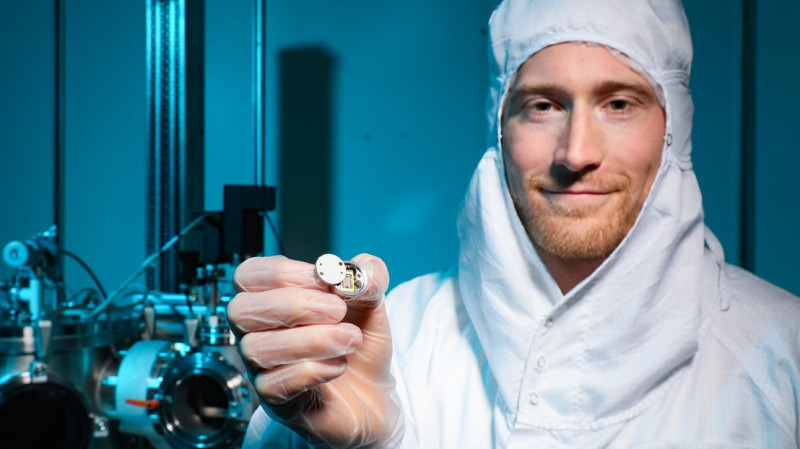
 Ian Rousseau, CEO of Hexisense, brings to the market a gallium nitride-based chip that can measure vaccums
Vacuums are a vital part of the processes - such as freeze-drying - used to make and preserve countless everyday items and must be measured with precision. An EPFL spin-off, Hexisense, is bringing to market a gallium nitride-based chip that can measure the quantity of certain gas molecules cheaply and with unrivalled precision. What do a mirror, a cup of yogurt, an electric car battery and an LED lightbulb have in common? Their production processes all require a vacuum, i.e. an environment in which gas molecules are removed. Usually, when the last drop has been poured from a bottle, the bottle is considered empty. Physically, however, it remains full of gas. When a vacuum is required, suction pumps leave a varying amount of gas depending on the process used. A vacuum is therefore assessed on the basis of pressure exerted by the number of molecules that remain in the container.
TO READ THIS ARTICLE, CREATE YOUR ACCOUNT
And extend your reading, free of charge and with no commitment.
Your Benefits
- Access to all content
- Receive newsmails for news and jobs
- Post ads