by Samuel Schlaefli, freelance author
A hundred years ago, a cadre of the world’s most renowned physicists embarked on a quest that would transform their field. The group - which included Werner Heisenberg, Erwin Schrödinger, Max Born and Wolfgang Pauli - laid the groundwork for quantum mechanics, a theory so radically different from classical physics that its concepts and language can be hard for non-scientists to grasp. In fact, quantum physics is so revolutionary that it even defies principles once regarded as immutable by classical physicists.
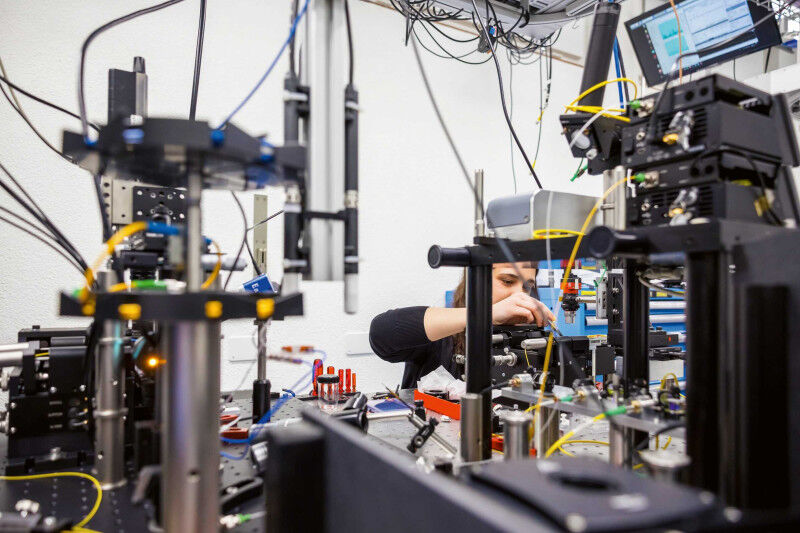
Quantum entanglement - where quantum objects such as electrons, photons or atoms become intrinsically connected - is one example; another is the idea of quantum teleportation. For decades, these concepts remained confined to theoretical thought experiments, and it wasn’t until the early 2000s that scientists were finally able to routinely demonstrate such effects in the lab. "We’ve now reached a stage where we can harness these phenomena for practical applications - and that requires a whole new class of engineers," says Frimmer. Quantum engineers are a breed apart, he explains: well versed in traditional engineering, but equally comfortable at the cutting edge of quantum science.
This text appeared in the 25/02 issue of the ETH magazine Globe.
Pioneering programme
Professor Frimmer is programme manager and one of the developers of the two-year ETH Master of Science in Quantum Engineering. When this programme launched in 2019, it was among the first in the world to blend a traditional engineering degree with a specialisation in quantum science. Though officially part of the Department of Information Technology and Electrical Engineering, it is run in collaboration with the Department of Physics. That means students can pick lectures from both departments and tailor the course to their individual interests.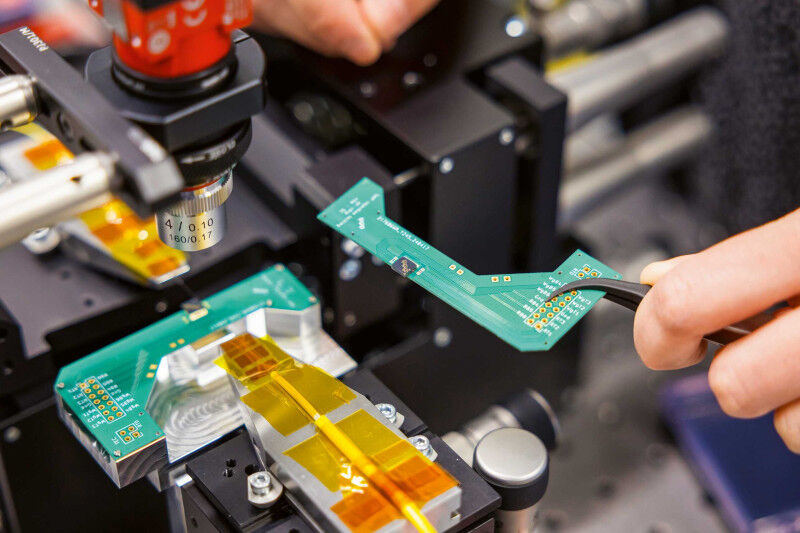
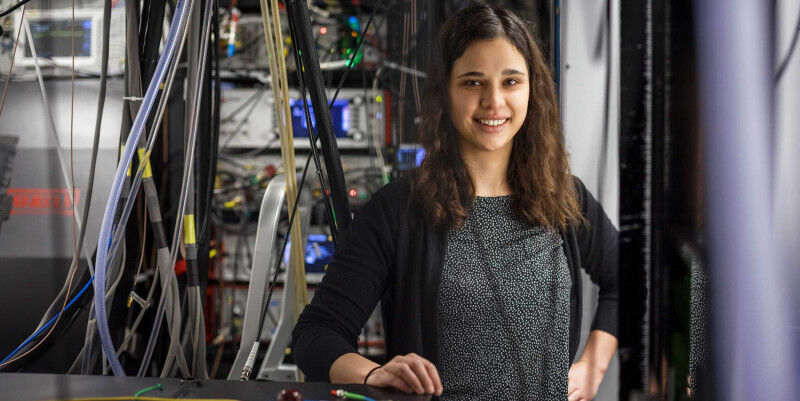
After earning a Bachelor’s degree in Physics and Engineering in Milan, Sophie Cavallini became part of one of the first cohorts of the ETH Master’s programme, which she completed last year. "I particularly enjoyed the hands-on approach, which was very different to what I was used to in Italy," she says. "The projects we worked on were really ambitious, sometimes even a bit futuristic." For the practical part of her studies, she joined Jonathan Home’s group in the Department of Physics. After graduating, she immediately started her doctoral studies in the same group. "We trap ions with electromagnetic fields and fire lasers at them to change their energy state," she says, summarising her work.
Her long-term goal is to develop integrated photonic chips that use light instead of electrical current. "The technology we’re working on is not only central to quantum computing but could also, for example, pave the way for a new generation of biosensors," she explains. During her studies, Cavallini, 24, was heavily involved in the Quantum Engineering Commission, a student association that organises summer barbecues, festive fondues, a weekly journal club where guest researchers can present their latest work, exchanges with other universities, and visits to companies. "I had no idea that socialising with my fellow students was going to be so much fun!" says Cavallini.
From Iceland to ETH
One of the first graduates from the Master’s programme was Björn Josteinsson. Since 2022, he’s been working at QZabre, an ETH spin-off that develops quantum microscopes. The company uses nitrogen-vacancy (NV) centres in diamond to measure magnetic and electric fields, current densities and temperatures at the nanometre scale. "I get to work right at the cutting edge of a groundbreaking technology," says Josteinsson. "We are developing measurement techniques that open up entirely new realms of possibility."Josteinsson, 28, grew up in Iceland and went on to study physics there at university. It was during his undergraduate degree that he first encountered quantum mechanics. "I wanted to delve deeper into quantum theory, but I was also keen to put theory into practice," he says. That kind of course wasn’t available in Iceland - but Zurich’s offering ticked all the boxes. During his studies, he says, he often felt like a child in a sweet shop: "There are so many labs at ETH working on fascinating quantum experiments, and we were able to get involved in almost all’of them. It was fantastic!" His first contact with QZabre was during his student internship. In the meantime, another graduate from the programme has joined the company, and most of QZabre’s interns are also drawn from the ETH Master’s in Quantum Engineering.
Frimmer says the Master’s programme already offers outstanding career prospects. "Almost every major technology company is conducting research into quantum applications," he says. Google, Microsoft, Amazon and also the chemical and pharmaceutical industries all’have teams working in this field. And while products based on quantum engineering are still thin on the ground, and a true quantum computer is still some way off, Frimmer notes that interest from industry is growing all the time.