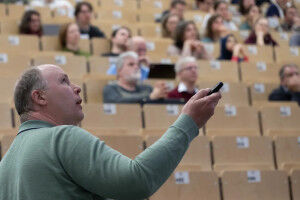
1/2 images In the lab Giulio Cocci (left) and Paolo Carpeggiani Giulio Cocci (left) and Paolo Carpeggiani
1/2 images In the lab Giulio Cocci ( left ) and Paolo Carpeggiani Giulio Cocci ( left ) and Paolo Carpeggiani - A completely new method of producing extremely short and high-energy laser pulses was developed at TU Wien. 1/2 images In the lab Giulio Cocci (left) and Paolo Carpeggiani Giulio Cocci (left) and Paolo Carpeggiani Laser pulses with extremely high energy play an important role in research today - applications range from atomic physics to the investigation of the atmosphere. However, many applications require laser beams with longer wavelengths than those that can be generated with conventional solid-state lasers. For a long time now, researchers have therefore been working on special tricks that can be used to increase the wavelength of a laser beam. A team from TU Wien, with support from scientists from Canada and Russia, has now pursued a completely new approach. The laser beam is sent through a narrow tube filled with nitrogen gas. When a photon of the laser beam comes into contact with a nitrogen molecule, it can lose a small amount of energy, thereby increasing the wavelength.
TO READ THIS ARTICLE, CREATE YOUR ACCOUNT
And extend your reading, free of charge and with no commitment.