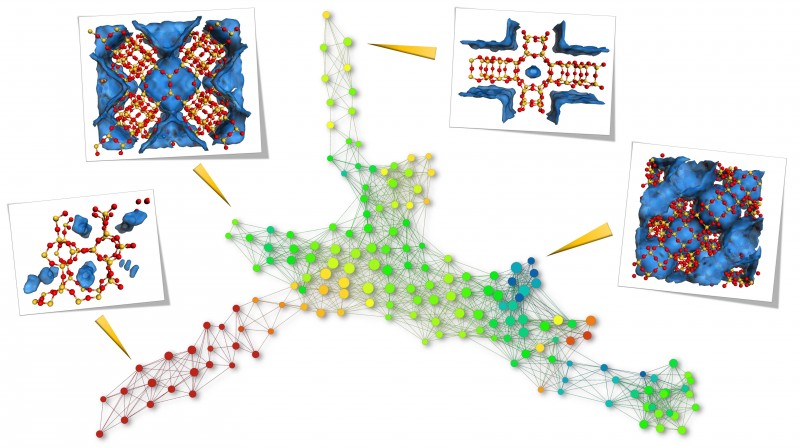
 Topological differences of top-performing materials for methane storage.
EPFL scientists have developed a mathematical 'face-recognition' method for identifying and discovering nanoporous materials based on their pore size. Image: Topological differences of top-performing materials for methane storage. Topological data analysis reveals the similarity between structures; each node represents a family of similar materials, while a network between two nodes indicates that they share at least one material. The further apart the nodes are, the more dissimilar the materials. The pictures show examples of nanoporous materials at the edges, and represent the topologically most different materials (red = Si, yellow = O, blue area = Pores). (Credit: Berend Smit/EPFL) Materials classified as 'nanoporous' have structures (or 'frameworks') with pores up to 100 nm in diameter. These include diverse materials used in different fields from gas separation, catalysis, and even medicine (e.g.
TO READ THIS ARTICLE, CREATE YOUR ACCOUNT
And extend your reading, free of charge and with no commitment.
Your Benefits
- Access to all content
- Receive newsmails for news and jobs
- Post ads