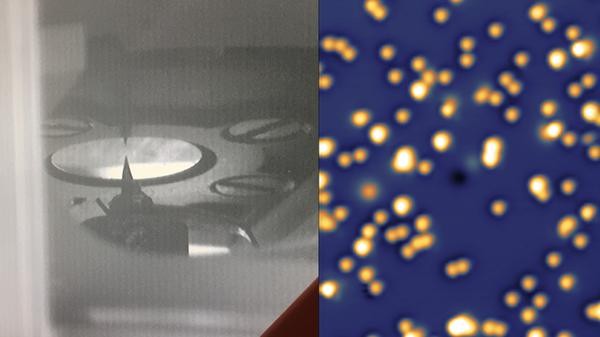
Left: Scanning Tunneling Microscope image of Holmium single-atom magnets. Right: Cobalt helper atoms on magnesium oxide.
Physicists at EPFL used Scanning Tunneling Microscopy to successfully test the stability of a magnet made up of a single atom. Despite the rise of solid-state drives, magnetic storage devices such as conventional hard drives and magnetic tapes are still very common. But as our data-storage needs are increasing at a rate of almost 15 million gigabytes per day, scientists are turning to alternative storage devices. One of these are single-atom magnets: storage devices consisting of individual atoms stuck ("adsorbed") on a surface, each atom able to store a single bit of data that can be written and read using quantum mechanics. And because atoms are tiny enough to be packed together densely, single-atom storage devices promise enormous data capacities. But although they are no longer science fiction, single-atom magnets are still in basic research, with many fundamental obstacles to be overcome before they can be implemented into commercial devices. EPFL has been at the forefront of the field, overcoming the issue of magnetic remanence , and showing that single-atom magnets can be used to read and write data.
TO READ THIS ARTICLE, CREATE YOUR ACCOUNT
And extend your reading, free of charge and with no commitment.