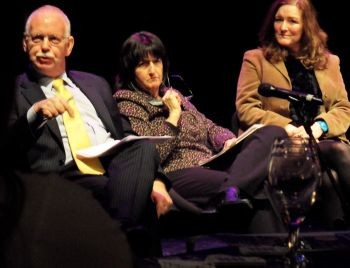
Sussex staff Judy Sebba (middle) and Dr Joanna Stephens (right, who chaired the salon discussion) listen carefully as Alan Dyson from the University of Manchester makes a point about educational inclusion.
All-inclusive or socially exclusive? Educational inclusion is a human right, decided the audience at the latest Sussex Salon debate, held at Brighton's Pavilion Theatre last night (Tuesday 7 February). The assembled gathering of local teachers, parents, students and elected councillors were able to share their views on this and other key questions about inclusion using an electronic voting system. The reality, they agreed, is that pupils with learning or physical disabilities can be educationally excluded because of a lack of political will, a shortage of resources, or the inexperience of hard-pressed teachers - or a by a combination of all of these factors. The Sussex Salon series of round-table discussions, organised by the School of Law, Politics and Sociology, offers a chance to hear academic opinion on hot topics of current public interest. A number of the panellists at this Salon, though, spoke from personal experience as well as from an academic standpoint. Judy Sebba, Professor of Education at Sussex, recalled the days when her cousin, born in the 1950s with a degenerative condition, was deemed "unsuitable for education at school". And Jacqui Shepherd, who teaches trainee teachers at Sussex, compared the experiences of her nine-year-old autistic son in mainstream and special schools.
TO READ THIS ARTICLE, CREATE YOUR ACCOUNT
And extend your reading, free of charge and with no commitment.