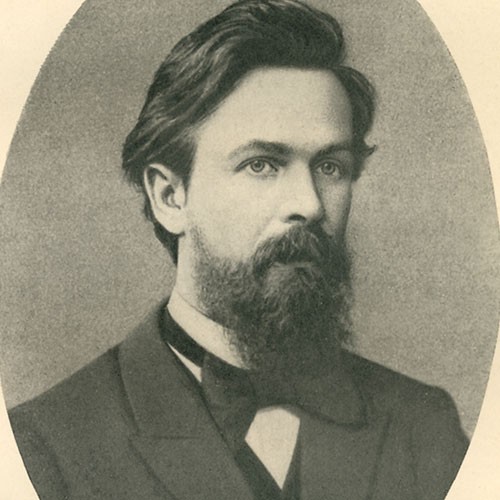
A century ago this week, Mathematician Andrey A. Markov delivered a lecture that day to the Imperial Academy of Sciences in St. Petersburg on a computational technique now called the Markov chain.
ComputeFest panel, part of Wintersession, explains Markov's pivotal breakthrough from a lecture 100 years ago. By Corydon Ireland Harvard News Office The Russian Revolution of 1917 was called the "Ten Days That Shook the World," the title of a book by foreign correspondent Jack Reed, Class of 1910. But how about the one day in Russia that shook the world, and still does? That was Jan. 23, 1913, a century ago this week. Mathematician Andrey A. Markov delivered a lecture that day to the Imperial Academy of Sciences in St. Petersburg on a computational technique now called the Markov chain. Little noticed in its day, his idea for modeling probability is fundamental to all of present-day science, statistics, and scientific computing. Any attempt to simulate probable events based on vast amounts of data - the weather, a Google search, the behavior of liquids - relies on Markov's idea.
TO READ THIS ARTICLE, CREATE YOUR ACCOUNT
And extend your reading, free of charge and with no commitment.