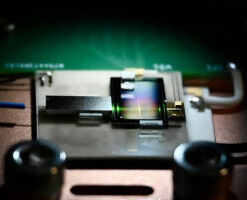
ANU wins $3 million for research on precision navigation device
Australia can be the leader in this new technology. Devices providing location information are critical for civilian and defence applications, and this is a multi-billion dollar industry that is rapidly growing. ANU researchers have won a $2.96 million contract from the Department of Defence to design a navigation device that does not need a GPS signal and could be used on submarines, ships, aircraft and land vehicles. Lead researchers Professor John Close and Associate Professor Nick Robins from the ANU Research School of Physics and Engineering said the new device, based on an ultra-cold atom laser, would make more precise measurements than today's technology. "Australia can be the leader in this new technology. Devices providing location information are critical for civilian and defence applications, and this is a multi-billion dollar industry that is rapidly growing," Professor Close said. "It's an important opportunity to build collaboration between the defence sector and academia in Australia that can lead to new technologies and a start-up defence technology culture." The device could be fitted on board a submarine, aeroplane or other types of vehicles to precisely detect acceleration, gravity, rotation and time, Professor Close said. "As long as you know the starting point and a map, this device could be used to pinpoint the location," he said.