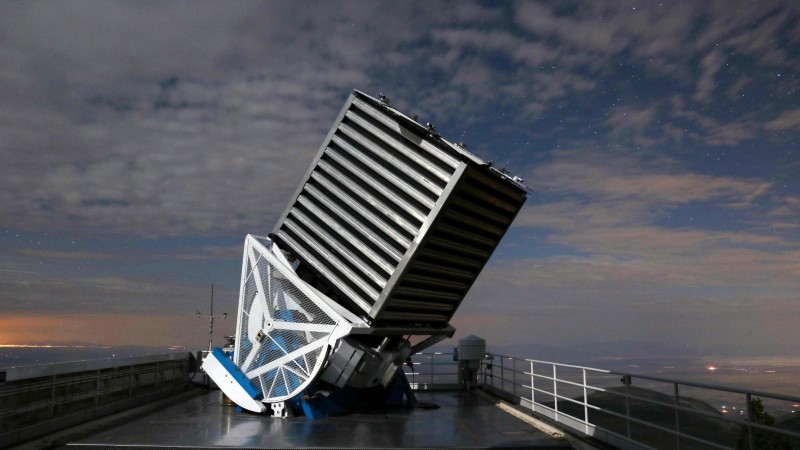
 One of the SDSS telescopes at Apache Point Observatory in New Mexico (USA)
Astronomers of the extended Baryonic Oscillation Spectroscopic Survey, led by EPFL Professor Jean-Paul Kneib, used the Sloan telescope to create the first map of the Universe based entirely on quasars. Quasars are incredibly bright and distant points of light powered by supermassive black holes. As matter and energy fall into the black hole, they heat up to incredible temperatures and begin to glow with excessive brightness. By observing this cosmic glow, the scientists of the multi-institutional Sloan Digital Sky Survey (SDSS) , which includes EPFL, have constructed the largest map of the distant Universe to-date. The work will be published in the Monthly Notices of the Royal Astronomical Society (link to preprint) . Quasars are supermassive black holes at the centers of galaxies and they radiate huge amounts of electromagnetic energy. 'Because quasars are so bright, we can see them all the way across the Universe,' says study co-leader Ashley Ross (Ohio State University).
TO READ THIS ARTICLE, CREATE YOUR ACCOUNT
And extend your reading, free of charge and with no commitment.
Your Benefits
- Access to all content
- Receive newsmails for news and jobs
- Post ads