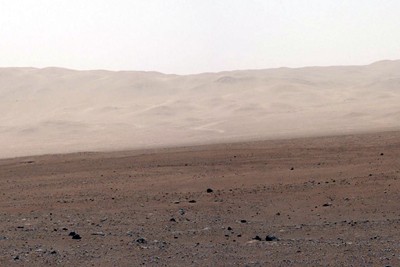
A color image from Curiosity of the wall of Gale Crater, the rover’s Aug. 6 landing site.
In a daring feat of technological nerve and skill, NASA landed a 1-ton rover on the surface of Mars Aug. The rolling laboratory is designed to help answer the question humans most want to know about Mars: Is there now or has there ever been life on the Red Planet? The rover, named Curiosity, holds equipment designed to look at environments where life might have existed and to assess whether those environments preserve evidence of past life. But none of it would have happened if even one thing had gone wrong with the landing sequence, which according to NASA required six vehicle configurations, 76 pyrotechnic devices, the largest supersonic parachute ever built and more than 500,000 lines of code. The "seven minutes of terror" before Curiosity landed safely on Mars was particularly nail-biting for the Cornell astronomers who are members of Curiosity's science team. "The landing site looks as interesting as was predicted, so Curiosity is now ready for an incredibly rich exploration of Mars' history," said Peter Thomas, who - along with Rob Sullivan, both senior research associates at Cornell's Center for Radiophysics and Space Research - works on the Mars Science Laboratory's camera science team with three instruments: mast cameras ("Mastcam"), a descent imager and a hand lens imager for close-up pictures. The Mastcam consists of two digital color cameras mounted high on Curiosity's mast. The right Mastcam has a telephoto lens with a three-fold better resolution than any previous landscape-viewing camera on the surface of Mars.
TO READ THIS ARTICLE, CREATE YOUR ACCOUNT
And extend your reading, free of charge and with no commitment.