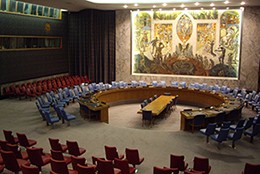
UN Security Council Chamber, photo taken from
Australia should prepare to play a leading role among elected members on the UN Security Council now that it has won a seat, says a leading United Nations expert from The Australian National University. Jeremy Farrall, a Fellow in the Asia-Pacific College of Diplomacy at the ANU College of Asia and the Pacific and a former Political Affairs Officer with the UN Security Council, said Australia had a real opportunity to stand out from other elected members during its two-year tenure on the Council. "In the current Security Council, three elected members - Germany, India and South Africa - could make a strong claim to becoming a permanent member if the Security Council were to expand its membership beyond 15. But all three of these leading elected members will have left the Security Council when Australia assumes its seat," said Farrall. "Of the 10 elected members in 2013, five will be small powers (Azerbaijan, Guatemala, Togo, Luxembourg and Rwanda) and five will be middle powers (Argentina, Australia, Morocco, Pakistan and South Korea). All of these middle powers can make solid contributions to the Security Council, but none of them could lay a realistic claim to holding a permanent seat if the Security Council were to expand. This provides Australia with a leadership opportunity and responsibility among the 2013 elected members.
TO READ THIS ARTICLE, CREATE YOUR ACCOUNT
And extend your reading, free of charge and with no commitment.