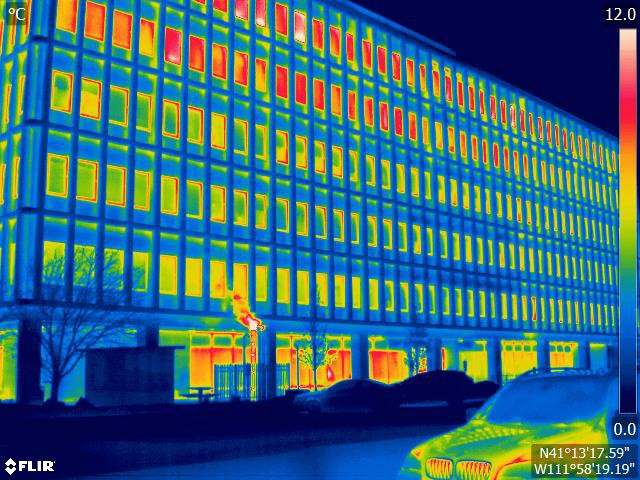
A thermal image of the Hansen Federal Building in Ogden, Utah, where Berkeley Lab performed a window retrofit study. (Credit: Berkeley Lab Windows and Envelope Materials Group)
More than $4 million awarded for projects on high-tech insulation, HVAC control, and moisture resistance that could save billions in energy costs. Lawrence Berkeley National Laboratory (Berkeley Lab) has been awarded more than $4 million by the Department of Energy (DOE) to undertake three projects aimed at improving the energy efficiency of buildings, which account for more than 40 percent of the country's energy consumption and greenhouse gas emissions. The projects, including a nanoparticle-based super insulation, a platform for automated building controls, and an advanced moisture modeling tool, will help meet the DOE goal to reduce the energy intensity of the U.S. building sector by 30 percent by 2030. On average, nearly a third of the energy used in buildings is wasted. It's estimated that if the U.S. reduced energy use in buildings by 20 percent, the nation could save nearly $80 billion annually on energy bills. 'Berkeley Lab has been at the forefront of building technologies research for more than 30 years, having pioneered innovations such as efficient lighting, low-emissivity windows, and versatile tools for building designers,' said Ramamoorthy Ramesh, Associate Lab Director for Energy Technologies. 'We are continuing to build on that foundation while utilizing more from the science toolkit, such as advanced materials and nanoscience.' Nanoparticle insulation The super insulation project is led by Berkeley Lab scientist Ravi Prasher, who discovered almost 10 years ago that nanoparticles could be assembled in a way to control the heat flow through them.
TO READ THIS ARTICLE, CREATE YOUR ACCOUNT
And extend your reading, free of charge and with no commitment.