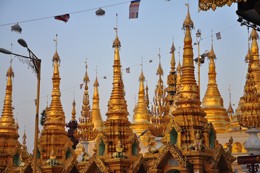
Shwedagon Pagoda, constructed in the 6th century and located in Yangon, Burma. Photo: Roger Price / Flickr
New parliaments and a new year - Nicholas Farrelly looks at the challenges for Burma and its democracy movement as the military attempts to remake the country's image. Early in 2011 the penultimate step in Burma's 'seven-step roadmap to democracy? will see representatives take their seats in the country's sixteen new parliaments ' quite an increase for a country accustomed to being governed in secret by a small group of senior military officers. Three-quarters of these new political figures were elected in November, when the people of Burma went to the polls for the first time in two decades; the rest are military appointees. Seeking to break the unwieldy stalemates of domestic politics, and also to curry favour internationally, Burma's military leadership has adopted a strategy which it hopes will enable its country to begin shaking off its pariah reputation. Joining the spectrum of internationally palatable Southeast Asian semi-democracies 'countries like Singapore, Thailand and Malaysia - is its long-term goal. New faces will populate Burma's constellation of national parliamentary institutions and regional assemblies. Active-duty and retired military officers will come out of the shadows to begin careers as parliamentarians, and a selection of elected entrepreneurs, ethnic leaders, technocrats and political fixers will also find themselves part of the new political reality. Overseeing it all will be the ruling clique, headed by Senior General Than Shwe. Read the full article at Inside Story .
TO READ THIS ARTICLE, CREATE YOUR ACCOUNT
And extend your reading, free of charge and with no commitment.