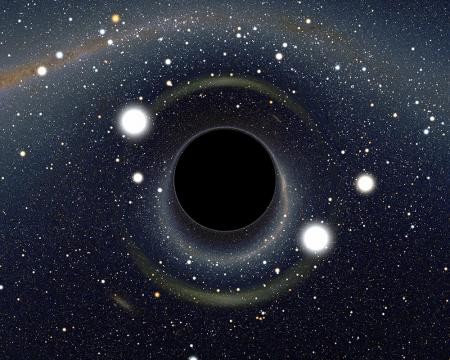
A computer-generated image of the light distortions created by a black hole. For more information: http://www2.iap.fr/users/riazuelo/bh/APOD.php
A new kind of cosmic flash may reveal something never seen before: the birth of a black hole. When a massive star exhausts its fuel, it collapses under its own gravity and produces a black hole, an object so dense that not even light can escape its gravitational grip. According to a new analysis by an astrophysicist at the California Institute of Technology (Caltech), just before the black hole forms, the dying star may generate a distinct burst of light that will allow astronomers to witness the birth of a new black hole for the first time. Tony Piro, a postdoctoral scholar at Caltech, describes this signature light burst in a paper published in the May 1 issue of the Astrophysical Journal Letters . While some dying stars that result in black holes explode as gamma-ray bursts, which are among the most energetic phenomena in the universe, those cases are rare, requiring exotic circumstances, Piro explains. "We don't think most run-of-the-mill black holes are created that way." In most cases, according to one hypothesis, a dying star produces a black hole without a bang or a flash: the star would seemingly vanish from the sky-an event dubbed an unnova. "You don't see a burst," he says.
TO READ THIS ARTICLE, CREATE YOUR ACCOUNT
And extend your reading, free of charge and with no commitment.