Black hole wakes up and has a light snack
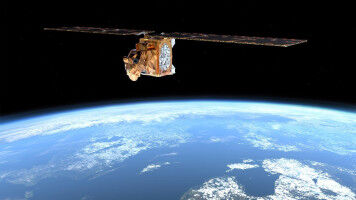
Astronomers have watched as a black hole woke up from a decades-long slumber to feed on a low-mass object - either a brown dwarf or a giant planet - that strayed too close. A similar feeding event, albeit on a gas cloud, will soon happen at the black hole at the centre of our own Milky Way Galaxy. The discovery in galaxy NGC 4845, 47 million light-years away, was made by ESA's Integral space observatory, with follow-up observations from ESA's XMM-Newton, NASA's Swift and Japan's MAXI X-ray monitor on the International Space Station. Astronomers were using Integral to study a different galaxy when they noticed a bright X-ray flare coming from another location in the same wide field-of-view. Using XMM-Newton, the origin was confirmed as NGC 4845, a galaxy never before detected at high energies. Along with Swift and MAXI, the emission was traced from its maximum in January 2011, when the galaxy brightened by a factor of a thousand, and then as it subsided over the course of the year. "The observation was completely unexpected, from a galaxy that has been quiet for at least 20-30 years," says Marek Nikolajuk of the University of Bialystok, Poland, lead author of the paper in Astronomy & Astrophysics .