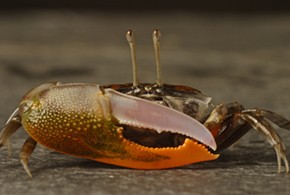
A fiddler crab stares into the camera. Photo by Jeff Wilson.
A study from The Australian National University has revealed for the first time how an animal sees and responds to predatory attacks in its natural environment. The study was undertaken by Dr Jochen Smolka, formerly of the ANU Research School of Biology and now based at Lund University in Sweden. He and his ANU colleagues, Professor Jochen Zeil and Dr Jan Hemmi, filmed a colony of fiddler crabs at the exact moment they were avoiding air-borne predators. Dr Smolka said that he and his co-researchers discovered that crabs use multiple visual cues to distinguish between friend and foe, react to attacks and increase their overall chance of survival. 'Crabs are hunted by fast and agile aerial predators such as terns,' said Dr Smolka. 'For example fiddler crabs need to take shelter from birds every two to three minutes. ?It is therefore essential for their survival to have a fast and effective escape mechanism. However due to the very limited resolution of their eyes, crabs only see an approaching bird as one or a few 'pixels' of their retinal image. ?This makes it impossible to distinguish the shape of a potential predator.
TO READ THIS ARTICLE, CREATE YOUR ACCOUNT
And extend your reading, free of charge and with no commitment.