Building a graphene-based nanotube biosensor
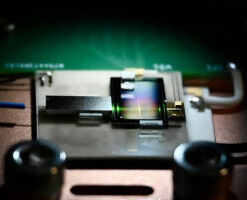
Summer Series: Edward Honein has joined EPFL's Laboratory of Nanobiotechnology from the American University of Beirut. His summer project, supervised by Professor Ardemis Boghossian, aims to develop a nanotube-based biosensor. Biosensors are devices that can detect biological molecules ("analytes") in air, water, or blood. They are used widely in drug development, medical diagnostics, biological research, and even security. Despite ongoing advancments, there remains a need for improved portable biosensing devices that are easy to use for both doctors and patients. The development of such devices would offer methods for continuous, real-time monitoring of biomarker levels, which is important for a number of diseases such as diabetes. This is where Edward Honein's summer project comes in: he is developing an optical, microfluidic biosensor that can detect single biomolecules in a scalable, high-throughput manner.

Links