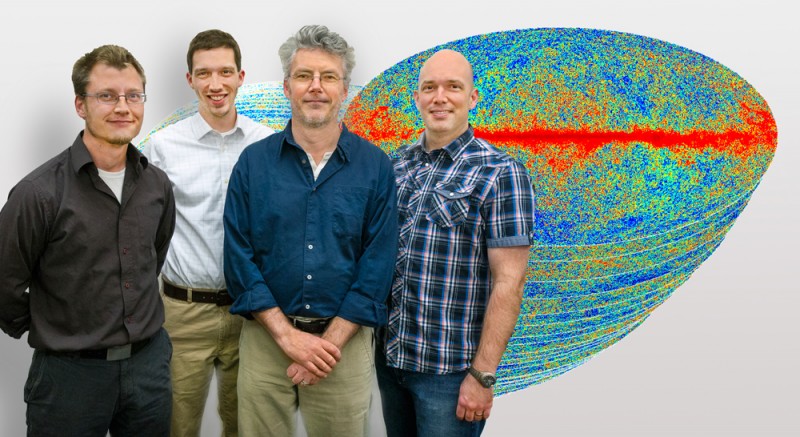
From left, Reijo Keskitalo, Aaron Collier, Julian Borrill, and Ted Kisner of the Computational Cosmology Center with some of the many thousands of simulations for Planck Full Focal Plane 6. (Photo by Roy Kaltschmidt)
To make the most precise measurement yet of the cosmic microwave background (CMB) - the remnant radiation from the big bang - the European Space Agency's (ESA's) Planck satellite mission has been collecting trillions of observations of the sky since the summer of 2009. On March 21, 2013, ESA and NASA, a major partner in Planck, will release preliminary cosmology results based on Planck's first 15 months of data. The results have required the intense creative efforts of a large international collaboration, with significant participation by the U.S. Planck Team based at NASA's Jet Propulsion Laboratory (JPL). Strength in data analysis is a major U.S. contribution, including the resources of the U.S. Department of Energy's National Energy Research Scientific Computing Center (NERSC) at Lawrence Berkeley National Laboratory and the expertise of scientists in Berkeley Lab's Computational Cosmology Center (C3). "NERSC supports the entire international Planck effort," says Julian Borrill of the Computational Research Division (CRD), who cofounded C3 in 2007 to bring together scientists from CRD and the Lab's Physics Division.
TO READ THIS ARTICLE, CREATE YOUR ACCOUNT
And extend your reading, free of charge and with no commitment.