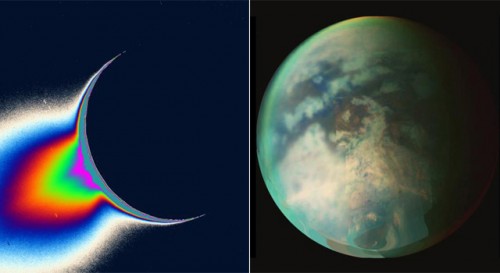
On the left, Saturn’s moon Enceladus is backlit by the sun, showing the fountain-like sources of the fine spray of material that towers over the south polar region. On the right, is a composite image of Titan. Image credit: NASA/JPL/SSI and NASA/JPL/University of Arizona
About a month and a half after its last double flyby, NASA's Cassini spacecraft will be turning another double play this week, visiting the geyser moon Enceladus and the hazy moon Titan. The alignment of the moons means that Cassini can catch glimpses of these two contrasting worlds within less than 48 hours, with no maneuver in between. Cassini will make its closest approach to Enceladus late at night on May 17 Pacific time, which is in the early hours of May 18 UTC. The spacecraft will pass within about 435 kilometers (270 miles) of the moon's surface. The main scientific goal at Enceladus will be to watch the sun play peekaboo behind the water-rich plume emanating from the moon's south polar region. Scientists using the ultraviolet imaging spectrograph will be able to use the flickering light to measure whether there is molecular nitrogen in the plume. Ammonia has already been detected in the plume and scientists know heat can decompose ammonia into nitrogen molecules.
TO READ THIS ARTICLE, CREATE YOUR ACCOUNT
And extend your reading, free of charge and with no commitment.