NGC 6334
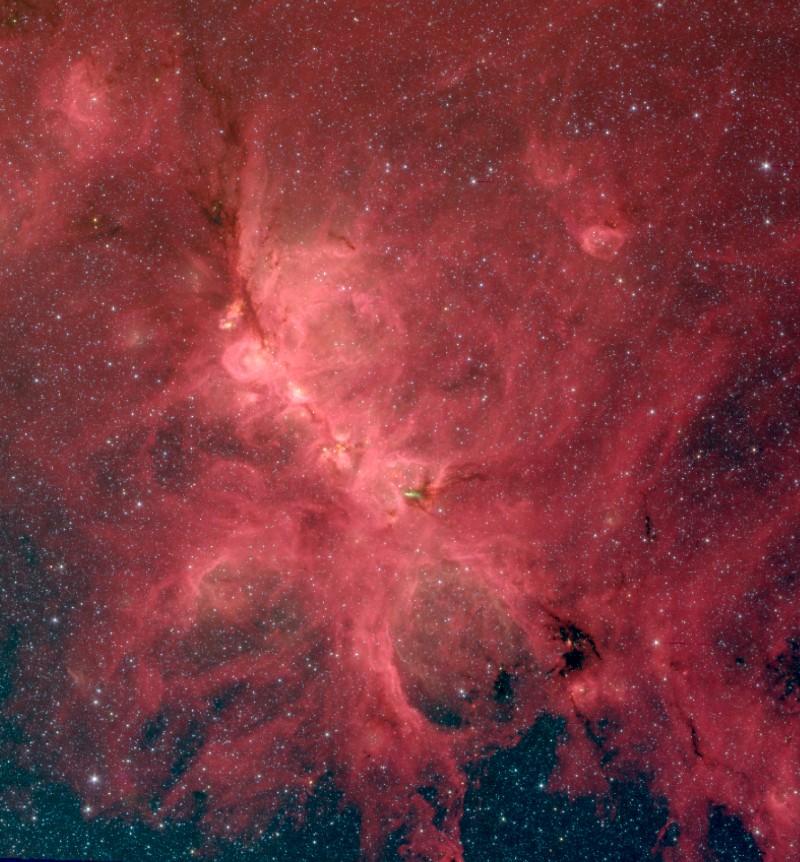
Indianapolis, IN - Most skygazers recognize the Orion Nebula, one of the closest stellar nurseries to Earth. Although it makes for great views in backyard telescopes, the Orion Nebula is far from the most prolific star-forming region in our galaxy. That distinction may go to one of the more dramatic stellar nurseries like the Cat's Paw Nebula, otherwise known as NGC 6334, which is experiencing a "baby boom." - "NGC 6334 is forming stars at a more rapid pace than Orion - so rapidly that it appears to be undergoing what might be called a burst of star formation," said lead author Sarah Willis of the Harvard-Smithsonian Center for Astrophysics (CfA) and Iowa State University. "It might resemble a 'mini-starburst,' similar to a scaled-down version of the spectacular bursts sometimes seen in other galaxies." - Willis presented a new study of NGC 6334 today in a press conference at a meeting of the American Astronomical Society. NGC 6334 is a realm of extremes. The nebula contains about 200,000 suns' worth of material that is coalescing to form new stars, some with up to 30 to 40 times as much mass as our Sun. It houses tens of thousands of recently formed stars, more than 2,000 of which are extremely young and still trapped inside their dusty cocoons.
TO READ THIS ARTICLE, CREATE YOUR ACCOUNT
And extend your reading, free of charge and with no commitment.