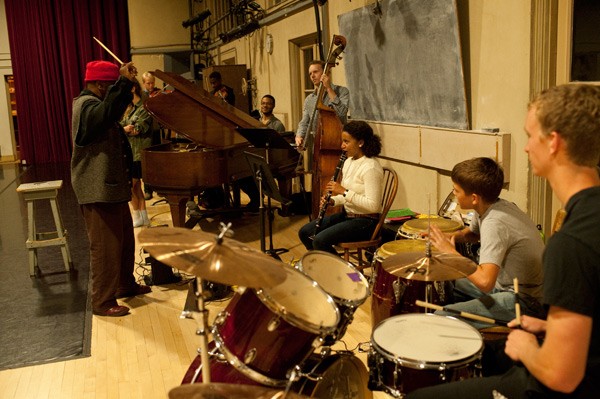
William Parker directs musicians in the Chocolate Heads movement band as they rehearse for their spring performance in the Bing Concert Hall.
Stanford Report, December 17, 2012 - The Stanford movement-driven band readies for its Bing Concert Hall debut with William Parker. Jazz visionary and Stanford visiting artist William Parker made a point of reminding the musicians in the Chocolate Heads movement band to "think about the dancers." That insightful instruction is uniting the sound and movement of the Heads as never before, and on the evening of March 8 the genre-mashing collective will share the Bing Concert Hall stage with Parker. "The Bing performance is going to be a performance of a lifetime," said Chocolate Heads student music director and pianist Tyler C. Brooks. "First and foremost, this is a tremendous honor; symbolically, what it means for a production so heavily co-directed by students to be the opening performance of Stanford's new landmark concert hall is overwhelmingly empowering. "It's a big step forward for Stanford student arts as much as it is for the Stanford arts in general." After a tour of the hall, the Heads concluded that it is a bar-none performance venue. "There's no myth about it: That place is special," said Brooks. "The acoustics, the facilities, the green room - Bing is the definition of state-of-the-art. I hope that two months is enough time to get the speechlessness and stage fright out of my system." The free concert at Bing is a christening of sorts because it will be the first time the marley floor is installed for a dance performance. The following night, March 9, Parker will premiere " Essence of Ellington " at Bing. The project features nine jazz luminaries, including Hamid Drake (drums) and Roy Campbell (trumpet), in a concert of Ellington standards and original compositions inspired by the Duke. What's a Chocolate Head?
TO READ THIS ARTICLE, CREATE YOUR ACCOUNT
And extend your reading, free of charge and with no commitment.