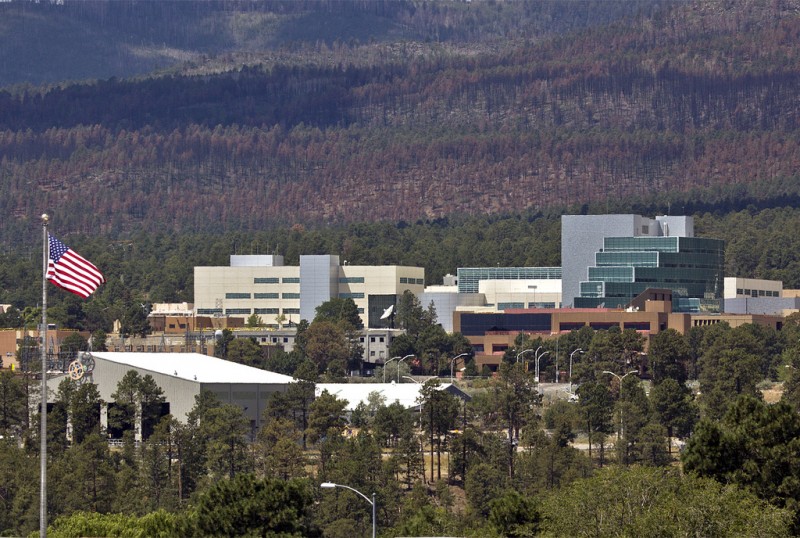
Los Alamos National Laboratory sits on top of a once-remote mesa in northern New Mexico with the Jemez mountains as a backdrop to research and innovation covering multi-disciplines from bioscience, sustainable energy sources, to plasma physics and new materials.
Called the Christmas Burst, GRB 101225A was freakishly lengthy and it produced radiation at unusually varying wavelengths. Old model, new data: A match made in the heavens LOS ALAMOS, New Mexico, December 1, 2011—A strangely powerful, long-lasting gamma-ray burst on Christmas Day, 2010 has finally been analyzed to the satisfaction of a multinational research team. Called the Christmas Burst, GRB 101225A was freakishly lengthy and it produced radiation at unusually varying wavelengths. But by matching the data with a model developed in 1998, the team was able to characterize the star explosion as a neutron star spiraling into the heart of its companion star. The paper, "The unusual gamma-ray burst GRB 101225A from a helium star/neutron star merger at redshift 0.33,” appears in tomorrow's issue of the journal Nature. Christina Thöne of Spain's Instituto de Astrofísica de Andalucía is the lead author, and Los Alamos computational scientist Chris Fryer is a contributor. Fryer of the Lab's Computer, Computational, and Statistical Sciences Division, realized that the peculiar evolution of the thermal emission (first showing X-rays with a characteristic radius of ~1011 cm followed by optical and infra-red emission at ~1014 cm) could be naturally explained by a model he and Stan Woosley of the University of California at Santa Cruz had developed in 1998.
TO READ THIS ARTICLE, CREATE YOUR ACCOUNT
And extend your reading, free of charge and with no commitment.