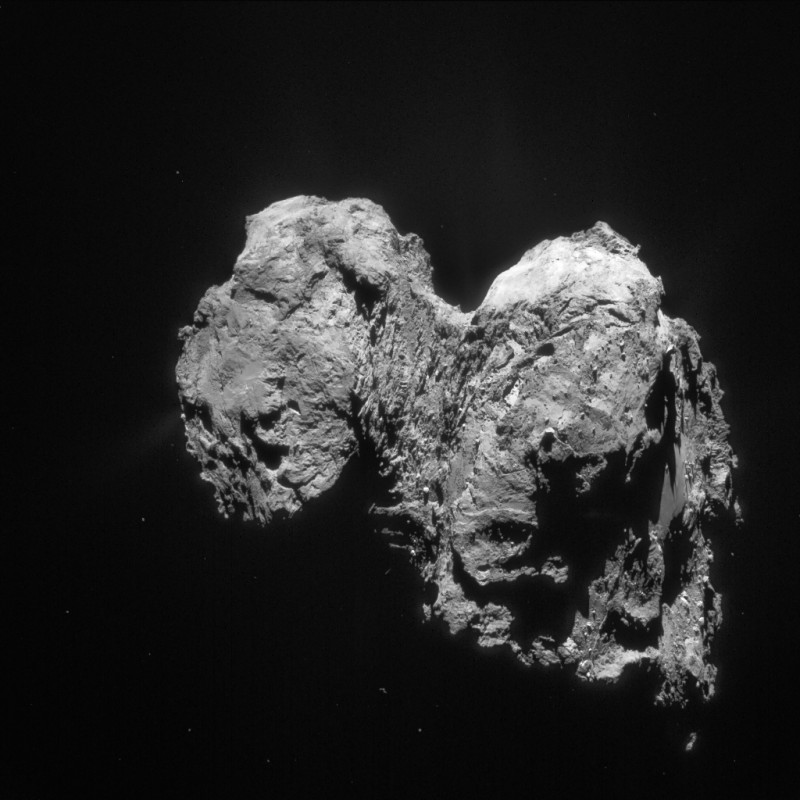
 «Chury» with his bi-lobe structure and the weakest part, the neck.
Based on computer simulations, Astrophysicists at the University of Bern conclude that the comet Chury did not obtain its duck-like form during the formation of our solar system 4.5 billion years ago. Although it does contain primordial material, they are able to show that the comet in its present form is hardly more than a billion years old. Based on data from the Rosetta space probe, scientists have so far assumed that the comet 67P/Churyumov-Gerasimenko originated from the initial phase of our solar system. Its peculiar, duck-shaped structure would have resulted from a gentle collision of two objects about 4.5 billion years ago. Based on new research, Martin Jutzi and Willy Benz from NCCR PlanetS and the Center for Space and Habitability (CSH) of the University of Bern, together with colleagues, have now come to a different conclusion. As a result of two studies published in the specialist journal Astronomy & Astrophysics, Astrophysicist Martin Jutzi explains that "It is unlikely that a body like Chury has survived for such a long time without damage - our computer simulations show this. " If the assumptions of the present "standard" model of the origin of our solar system are correct, a quiet initial phase was followed by a period in which large bodies initiated higher velocities and more violent collisions.
TO READ THIS ARTICLE, CREATE YOUR ACCOUNT
And extend your reading, free of charge and with no commitment.
Your Benefits
- Access to all content
- Receive newsmails for news and jobs
- Post ads