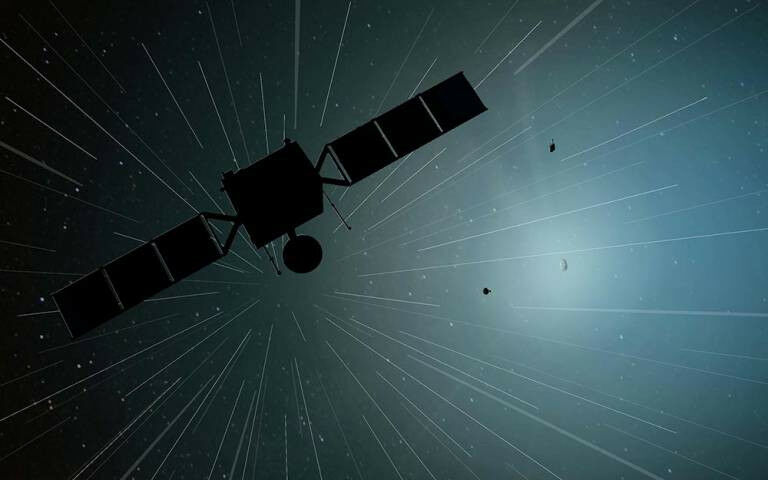
An artist's impression of the Comet Interceptor
An artist's impression of the Comet Interceptor - A European Space Agency science mission to 3D-map a comet for the first time, which was proposed by a UCL-led team, has reached a major milestone, moving from the design phase to implementation. The Comet Interceptor mission was formally adopted by ESA at a meeting in Madrid, with the next step to select a contractor to build the spacecraft and a robotic probe. Due for launch in 2029 it will see one main spacecraft and two robotic probes - the other built by the Japanese Space Agency - travel to an as-yet unidentified comet and map it in three dimensions. The mission was first proposed by an international team from Europe, Japan, and the US led by UCL's Professor Geraint Jones and Professor Colin Snodgrass of the University of Edinburgh. Professor Geraint Jones (UCL Mullard Space Science Laboratory) said: "This mission should give us our first glimpse of a truly pristine body - an invaluable example of the objects that came together to form the Earth and other planets. The comet's surface will be largely unchanged since the time of the Solar System's formation several billion years ago, and I can't wait to see that uncharted territory sometime in the 2030s. "It's fantastic to get the green light for the mission after almost four years of hard work since the European Space Agency's invitation to propose came out.
TO READ THIS ARTICLE, CREATE YOUR ACCOUNT
And extend your reading, free of charge and with no commitment.